
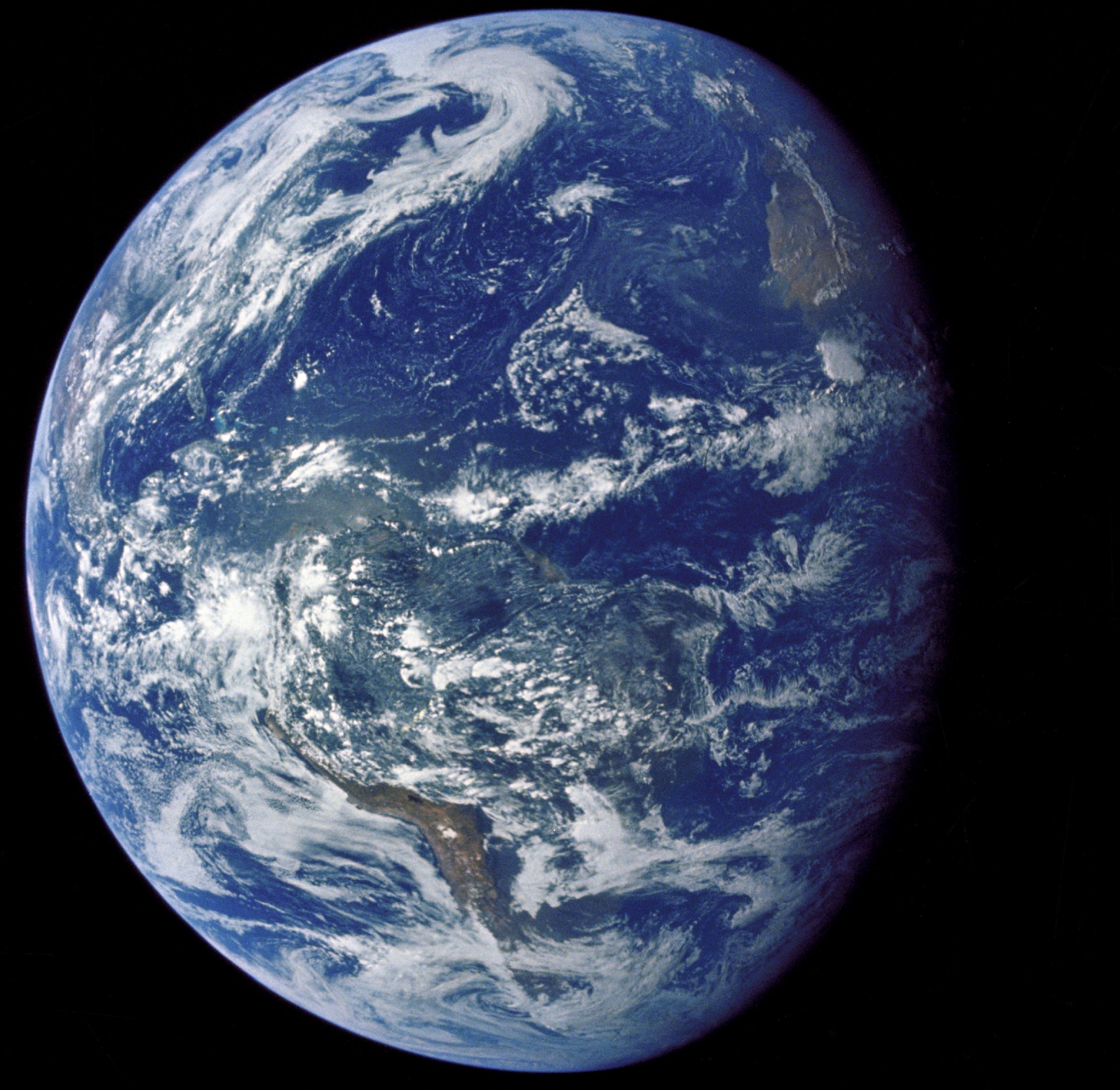
On July 26, 1971, the crew of Apollo 15 launched from Cape Kennedy, embarking on the first of the highly advanced “J-series” scientific expeditions designed to push human exploration deeper into the rugged lunar highlands. Floating roughly 30,000 nautical miles away in the sterile vacuum of space during their outward translunar coast, astronauts David Scott, Alfred Worden, and James Irwin pointed their heavy 70mm Hasselblad camera back toward their departing home.
The resulting photograph captured a striking perspective of the planet: a vibrant, fragile crescent of deep blue oceans and complex white cloud formations hanging suspended against the absolute void of the cosmic backdrop. This breathtaking, high-resolution imagery provided meteorologists and planetary scientists with rare, invaluable global data regarding large-scale atmospheric circulation and cloud dynamics across entire hemispheres simultaneously.
Beyond its immense scientific value, this dramatic crescent view provided a profound, perspective-shifting layer of ecological and philosophical insight to a global public. Unlike later fully illuminated views, the stark division between sunlight and absolute shadow in this photograph beautifully emphasized the intense vulnerability and isolation of our shared home.
The visual majesty of a lonely, brilliant sliver of life hanging precariously in an unforgiving expanse of dark space deeply resonated with the public, contributing meaningfully to the rapidly growing environmental movement of the early 1970s. By capturing the planet not as an endless world, but as a bounded, precious oasis in a vast cosmic desert, the crew of Apollo 15 delivered an enduring masterpiece of space photography that transformed the abstract concept of global preservation into an urgent human duty.
