
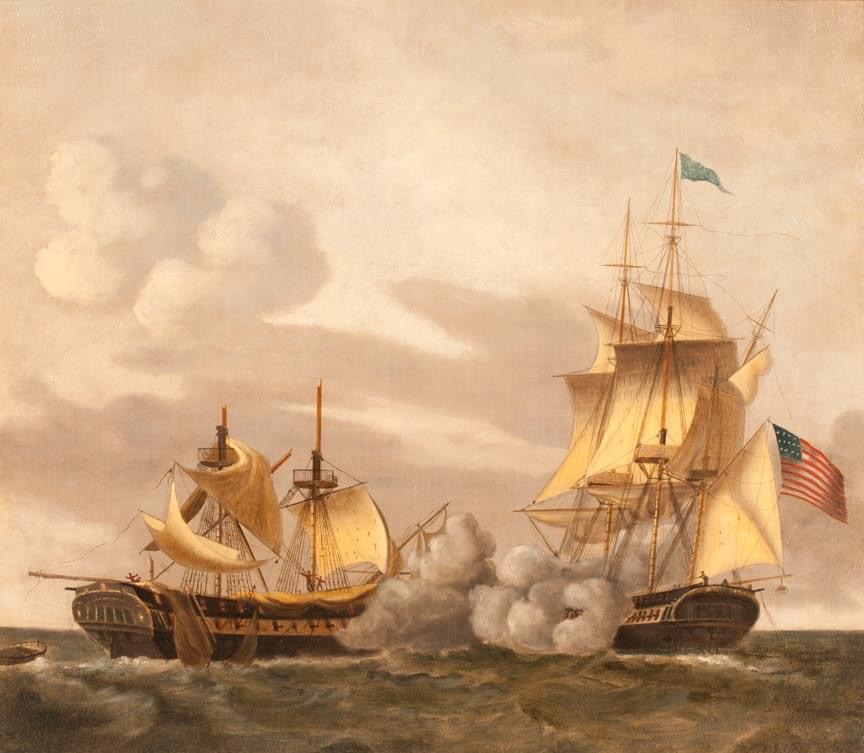
On October 25, 1812, the heavy frigate USS United States, commanded by Commodore Stephen Decatur, engaged and captured HMS Macedonian, commanded by Captain John Surman Carden, in the Atlantic south of the Azores. Decatur sought to fight at long range, where his ship’s 24-pounder guns gave him an advantage over the British frigate’s 18-pounders. British participant Samuel Leech later recalled that Carden initially mistook the American vessel for Essex, whose carronade-heavy armament would have made a distant engagement more favorable to the British.
The battle developed largely to Decatur’s advantage. Although the opening American broadside was inaccurate, the next brought down Macedonian’s mizzen topmast, impairing her maneuverability. United States then took position off the British frigate’s quarter and subjected her to destructive fire. By noon, Macedonian was dismasted and unable to continue effective resistance, forcing Carden to strike his colors. The U.S. Navy’s historical account records 104 British casualties against 12 aboard United States, which emerged comparatively little damaged. The result reflected both effective American gunnery and Decatur’s exploitation of his heavier armament.
After the surrender, Decatur received the defeated officers courteously. According to Leech’s later account, he either declined Carden’s offered sword or returned it immediately. The Americans then spent more than two weeks making Macedonian seaworthy before sailing home with their prize. Her capture prompted national celebrations, and the British frigate subsequently entered American naval service—turning a decisive battlefield success into both a public triumph and a material gain for the young U.S. Navy.
