
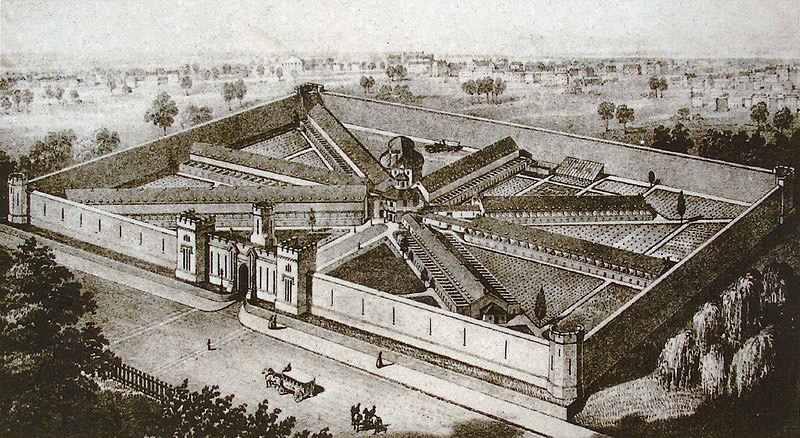
On October 25, 1829, Eastern State Penitentiary opened in Philadelphia, Pennsylvania, introducing an ambitious experiment in prison architecture and reform. Designed by British-born architect John Haviland, the fortress-like institution embodied the “Pennsylvania System,” which sought to encourage penitence through separate confinement, labor, and reflection. Its radial plan arranged seven cellblocks around a central observation hub, allowing guards to survey the corridors from one location. The original design called for single-story wings, but four were built with two stories to accommodate more prisoners.
The system’s defining principle was separation: reformers believed that isolation from other prisoners would encourage moral rehabilitation. Individual cells featured vaulted ceilings, skylights, central heating, running water, and flush toilets—unusual amenities for the period—with adjoining private exercise yards. Yet these comforts accompanied severe restrictions on contact with fellow prisoners. Separation did not mean the absence of all human interaction: the system provided for daily contact with the warden and overseers.
In practice, strict separation began breaking down long before its official abandonment in 1913, as overcrowding forced prisoners to share spaces intended for solitary confinement. Nevertheless, Eastern State’s architectural and penal model influenced more than 300 prisons worldwide. Its experiment also attracted prominent critics, including Charles Dickens, who condemned the psychological suffering caused by enforced solitude. Today, the historic site operates as a museum, inviting visitors to examine how architecture became an instrument of punishment and attempted reform.
Photograph by Mike Graham, via Wikimedia Commons (CC BY 2.0).
