
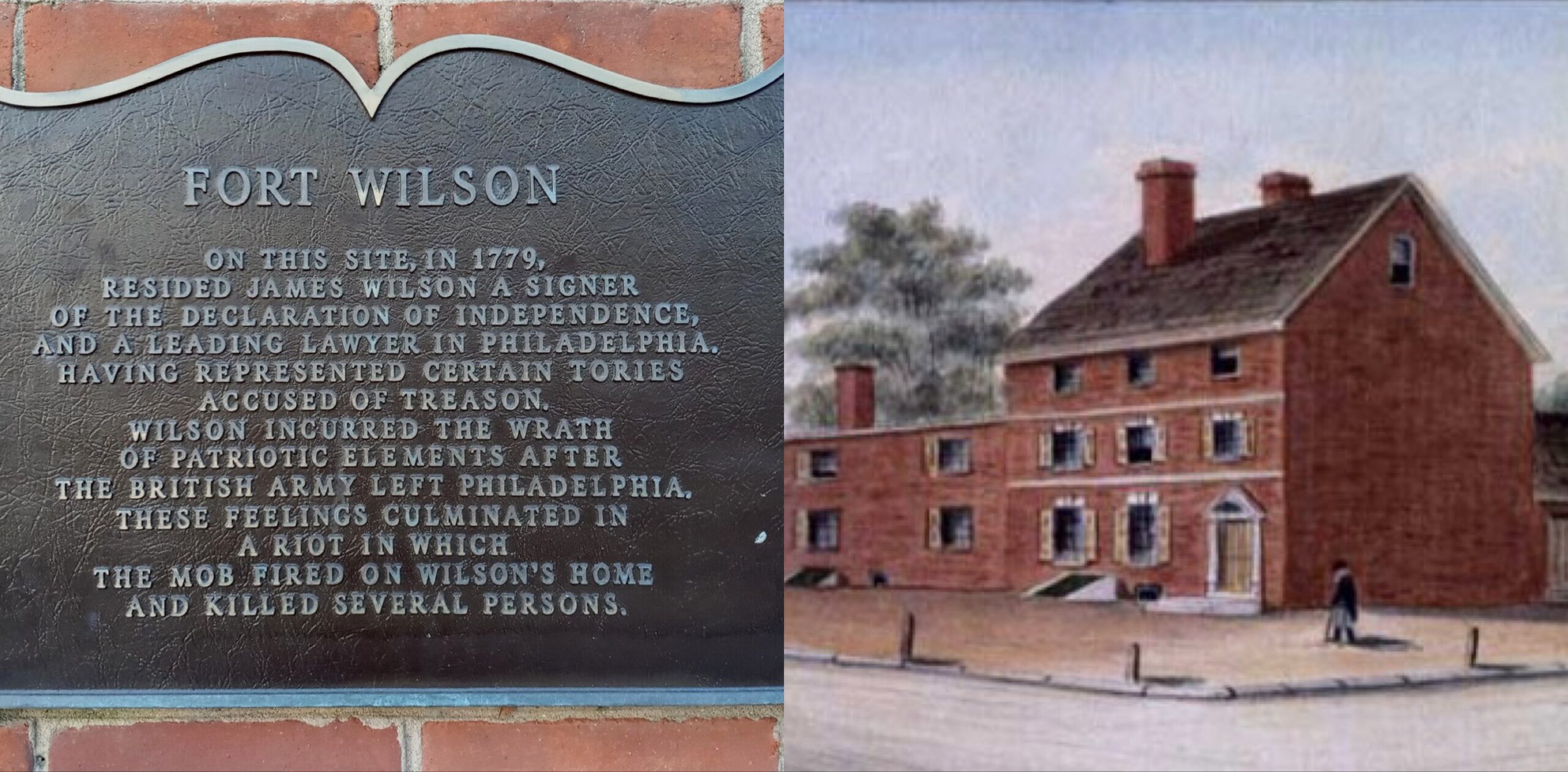
Philadelphia’s revolutionary political and economic tensions erupted into deadly street violence on October 4, 1779, when armed militiamen and their supporters attacked the home of James Wilson. Wilson, a prominent lawyer and signer of the Declaration of Independence, had become a target for Pennsylvania’s radical political faction because he opposed price controls and defended people accused of Loyalist sympathies or threatened with confiscation of their property. Amid wartime inflation, food shortages, and resentment of merchants and political elites, the confrontation exposed bitter disagreements over who qualified as a patriot—and what the Revolution’s promise of liberty should mean in practice.
The crowd marched through Philadelphia after gathering at Burns Tavern and confronting several prominent merchants. It eventually reached Wilson’s brick home at the southwest corner of Third and Walnut Streets, where Wilson and a group of political allies had barricaded themselves inside. Accounts differ over precisely what sparked the shooting, but Captain Robert Campbell, one of the defenders, was killed after confronting the crowd from the house. The attackers attempted to force their way in and reportedly set fire to part of the first floor, while the defenders fired from within.
The siege ended when Joseph Reed, president of Pennsylvania’s Supreme Executive Council, arrived with the City Troop of Light Horse; some accounts also identify Continental light dragoons among the forces that dispersed the crowd. The violence left Campbell and several members of the attacking crowd dead, with many more wounded. Estimates vary, a reminder that the event was contested in both its moment and its memory.
Later known as the “Fort Wilson Riot,” the clash demonstrated that the American Revolution had not produced a single, agreed-upon vision of republican government. Instead, Philadelphians fought over economic regulation, political power, loyalty, class, and the limits of popular action. The riot showed that the Revolution’s language of liberty could unite people against British rule while also dividing them sharply against one another.
Images via Wikimedia Commons
