
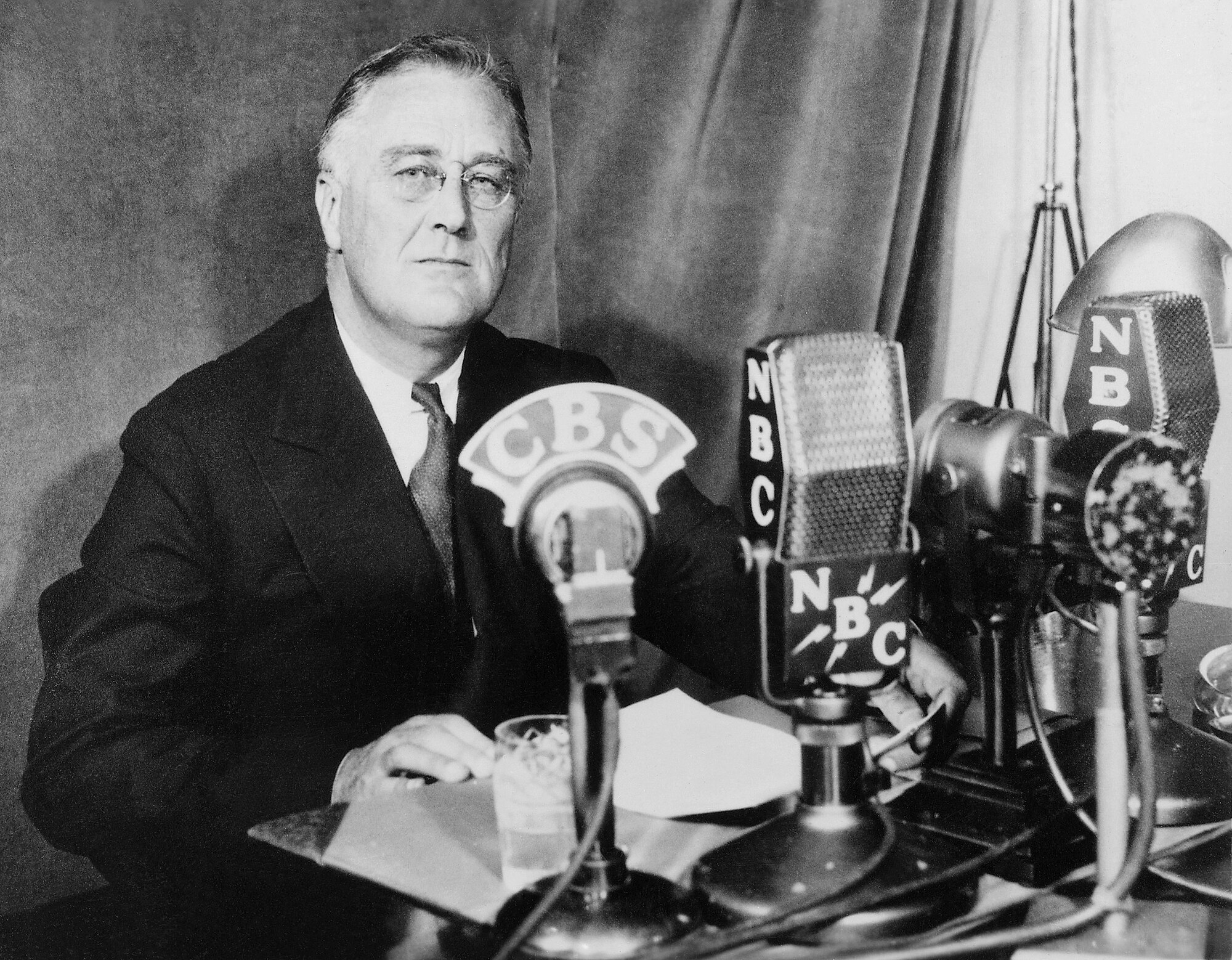
On the evening of September 30, 1934, President Franklin D. Roosevelt delivered his sixth national radio address from the White House. The broadcast—now known as a Fireside Chat—came at a consequential moment in the Great Depression, as the administration faced mounting arguments over the proper relationship between government, business, labor, and economic recovery.
In the address, often identified as “On Government and Capitalism,” Roosevelt defended the New Deal’s recovery program, especially the National Recovery Administration (NRA). He argued that NRA codes of fair competition had helped eliminate child labor in covered industries, shorten hours, establish minimum wages, and contribute to the reemployment of millions of people. He also defended federal spending on public works and relief, insisting that widespread unemployment was a greater national waste than the cost of recovery measures.
Roosevelt rejected both the idea that government should take over all business and the claim that any federal assistance to private enterprise threatened liberty. Instead, he presented the New Deal as a practical, distinctly American response to concrete economic problems—one intended to preserve fair profits while protecting workers and expanding security for ordinary families. Calling for an “armistice” between business and labor, he framed recovery as a shared national task.
Near the end of the speech, Roosevelt invoked Abraham Lincoln’s view that government should do what people cannot do as effectively on their own. “I still believe in ideals,” he declared, before contrasting the freedom of the privileged few with “greater freedom” and “greater security for the average man.”
The September 30 address demonstrates Roosevelt’s remarkable use of radio to explain complex policies in direct, accessible language. Rather than merely announcing legislation, he used the medium to define the political and moral purpose of the New Deal and to make the case that economic security was compatible with American liberty.
Image credit: Franklin D. Roosevelt delivering a national radio address, via Wikimedia Commons, public domain.
