
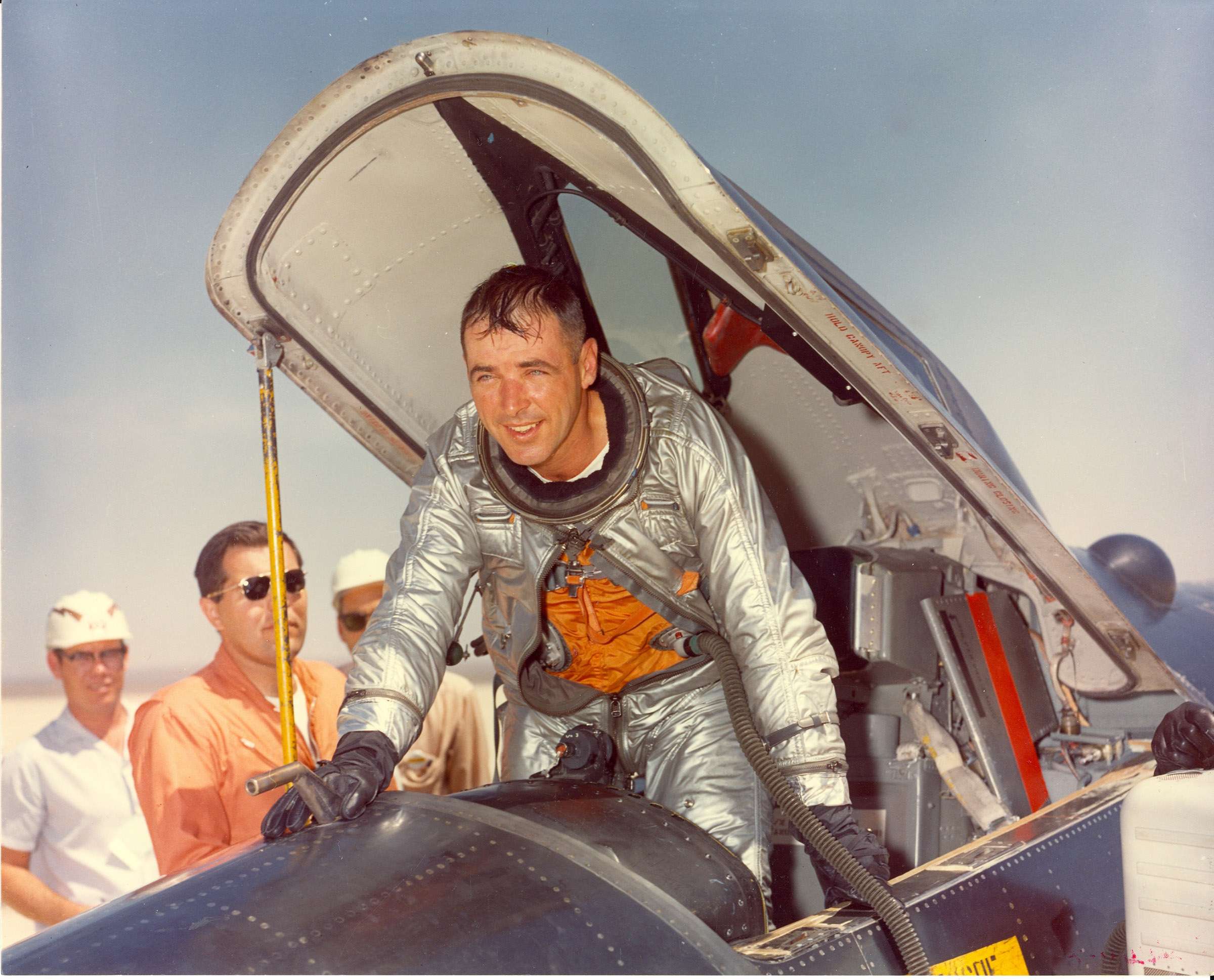
On November 9, 1961, U.S. Air Force test pilot Robert Michael White became the first person to fly a winged aircraft faster than Mach 6. Piloting the rocket-powered North American X-15, he reached Mach 6.04—approximately 4,093 miles per hour. The flight marked a major milestone in the effort to understand how an aircraft could withstand and remain controllable at more than six times the speed of sound.
The X-15 was a flying laboratory developed through a joint program involving NASA, the Air Force, the Navy, and North American Aviation. Its heat-resistant structure and specialized controls allowed researchers to investigate aerodynamic heating, structural loads, and pilot performance under conditions far beyond those of conventional flight. In denser air, pilots used aerodynamic control surfaces; at extreme altitudes, reaction-control thrusters helped orient the aircraft.
White’s achievements extended beyond speed. On July 17, 1962, he flew the X-15 to 314,750 feet—nearly 60 miles above sea level. By exceeding the Air Force’s 50-mile threshold for spaceflight, he qualified for astronaut wings, linking his career in experimental aviation with the emerging era of human space exploration.
The lasting importance of White’s Mach 6 flight lies in its place within the broader X-15 research program. Its missions produced data on hypersonic flight, high-altitude control, and the transition back to an unpowered landing. Those lessons later helped shape the Space Shuttle’s development and operating techniques. White’s November 9 achievement was both a remarkable personal milestone and a significant step toward understanding how pilots could guide winged vehicles through the demanding conditions at the edge of space.
