
On June 19, 1934, President Franklin D. Roosevelt signed the Communications Act into law, creating the Federal Communications Commission (FCC). The new agency replaced the old Federal Radio Commission and was granted sweeping new powers to regulate the chaotic, rapidly expanding worlds of wire and radio communication. Tasked with managing the airwaves in the “public interest, convenience, or necessity,” the early FCC had to mediate signal battles between pirate radio stations and commercial networks.
The creation of the FCC was largely driven by a hidden corporate war over the future of media. Major AM radio networks heavily lobbied the government to create strict licensing laws, hoping to crowd out educational, religious, and amateur operators from the dial. By establishing rigorous technical and bureaucratic hurdles, the early FCC unintentionally solidified a corporate monopoly over the airwaves, dictating what news and music ordinary Americans could access for decades.
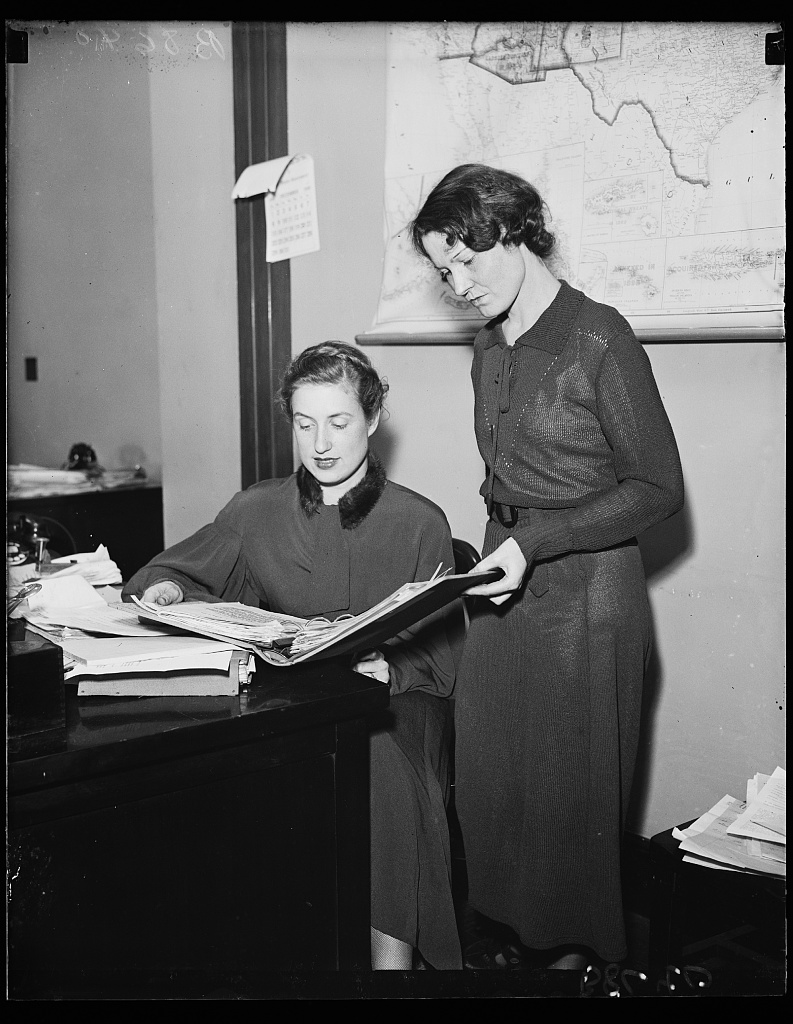
Image: These two young women are the latest addition to the legal staff at the Federal Communications Commission. Mary Elizabeth Erickson, left, recently of Washington State, is assigned to the broadcast section of the legal department, and Violet Lowry, of Hot Springs, Ark., is in the Telegraph Section in 1935 via Library of Congress, no known restrictions
