
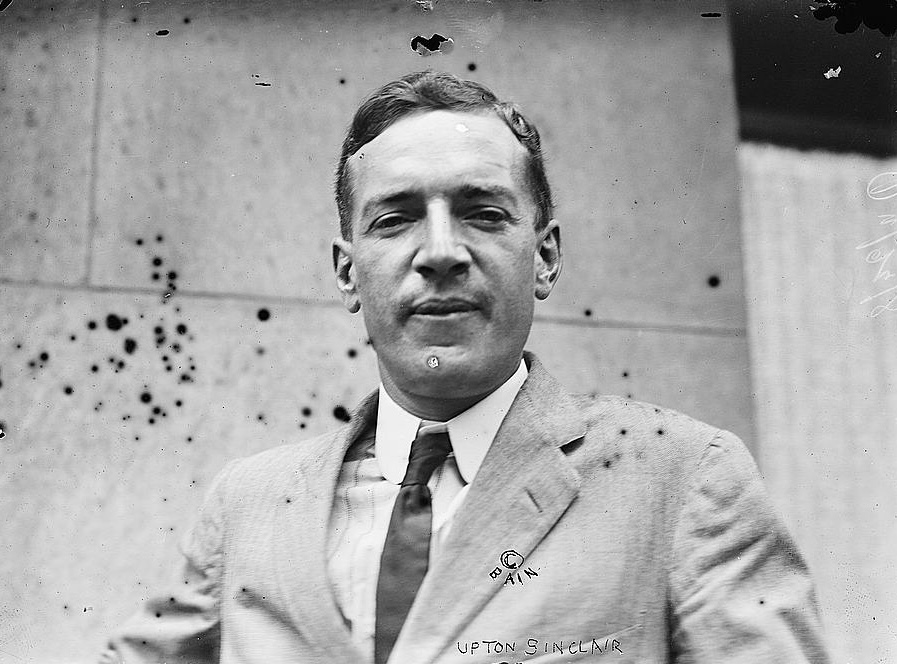
Upton Sinclair was born on September 20, 1878, in Baltimore, Maryland, into a life defined by sharp contrasts. His family often struggled financially, while wealthier relatives exposed him to a very different world of comfort and security. Seeing both poverty and privilege from a young age gave Sinclair an unusually intimate understanding of inequality—one that would become the driving force behind his writing.
Before he became a famous reformer, Sinclair was a young writer working constantly to survive. He supported himself through college by producing popular pulp fiction, learning how to create vivid scenes and stories that could hold a reader’s attention. That early training gave his later political writing its power: he did not just present facts about injustice; he made readers feel its human consequences.
His greatest work, The Jungle, emerged from this combination of moral outrage and storytelling skill. In 1904, Sinclair spent weeks investigating Chicago’s meatpacking district, listening to workers and witnessing the brutal realities of industrial labor. Rather than writing a dry report, he created the fictional immigrant family of Jurgis Rudkus, whose hopes for a better life collapse under unsafe work, poverty, corruption, and exploitation.
The shocking descriptions of contaminated meat made The Jungle a national sensation when it appeared in 1906. Public alarm helped drive support for the Pure Food and Drug Act and the Meat Inspection Act that same year. But Sinclair’s deeper goal was not only safer food; he wanted Americans to confront the way industrial capitalism could treat workers’ lives as disposable. As he later observed, “I aimed at the public’s heart, and by accident I hit it in the stomach.”
Sinclair’s lasting importance lies in the way he Upton Sinclair: The Life Behind The Jungle turned personal observation into public action. His early experience of insecurity, his disciplined life as a working writer, and his commitment to social justice shaped fiction that exposed the hidden costs of economic progress. He proved that a novel could be more than entertainment: it could become a weapon against indifference and a force for change.