
Thomas Hill was born in Birmingham, England, on September 11, 1829, and immigrated to the United States as a teenager. He became one of the best-known painters of the nineteenth-century American West, particularly celebrated for large, luminous landscapes of Yosemite Valley and the Sierra Nevada.
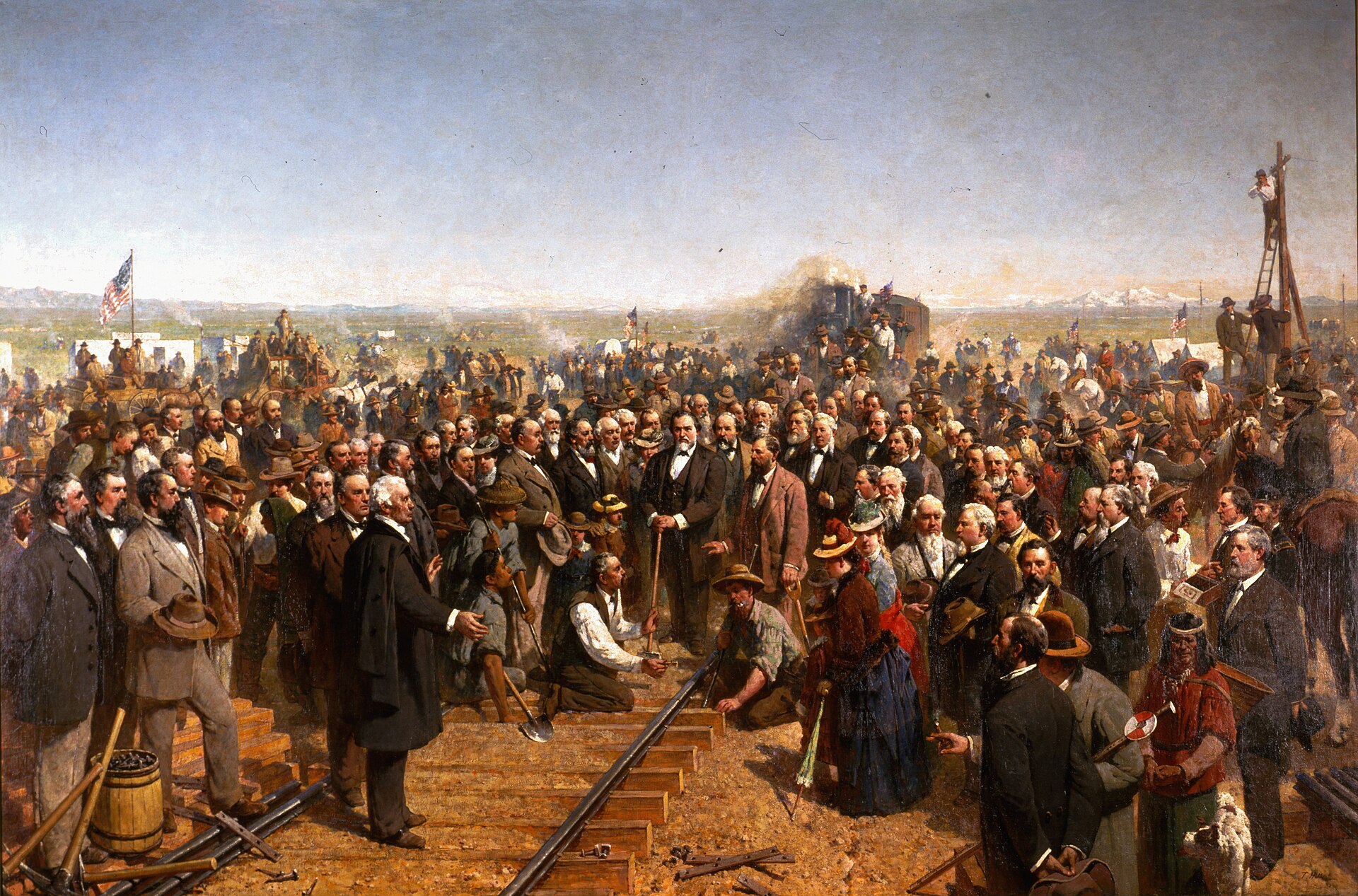
Among Hill’s most ambitious works is The Driving of the Last Spike (1881), a monumental oil painting measuring approximately 157¼ by 85¼ inches—about 13 by 7 feet. Commissioned in 1877 at the request of railroad magnate Leland Stanford, the painting commemorates the ceremony held at Promontory Summit, Utah, on May 10, 1869, when the Central Pacific and Union Pacific railroads were joined in the completion of the first transcontinental railroad.
Rather than functioning as a literal record of the occasion, Hill’s canvas is an idealized reconstruction. It gathers a large cast of railroad executives, engineers, workers, politicians, and guests into a carefully staged scene centered on Stanford and the ceremonial final spike. The painting thus reflects not only the national mythology that grew around the transcontinental railroad, but also the power of corporate patronage to shape how that achievement was remembered.
The commission had an unusual outcome. Although Stanford requested the painting, he later refused to pay Hill for it. The work nevertheless survived and is now displayed at the California State Railroad Museum, where visitors can compare Hill’s commemorative vision with photographs and other evidence from the actual 1869 ceremony.
Image: Thomas Hill, The Driving of the Last Spike (1881), California State Railroad Museum.
