
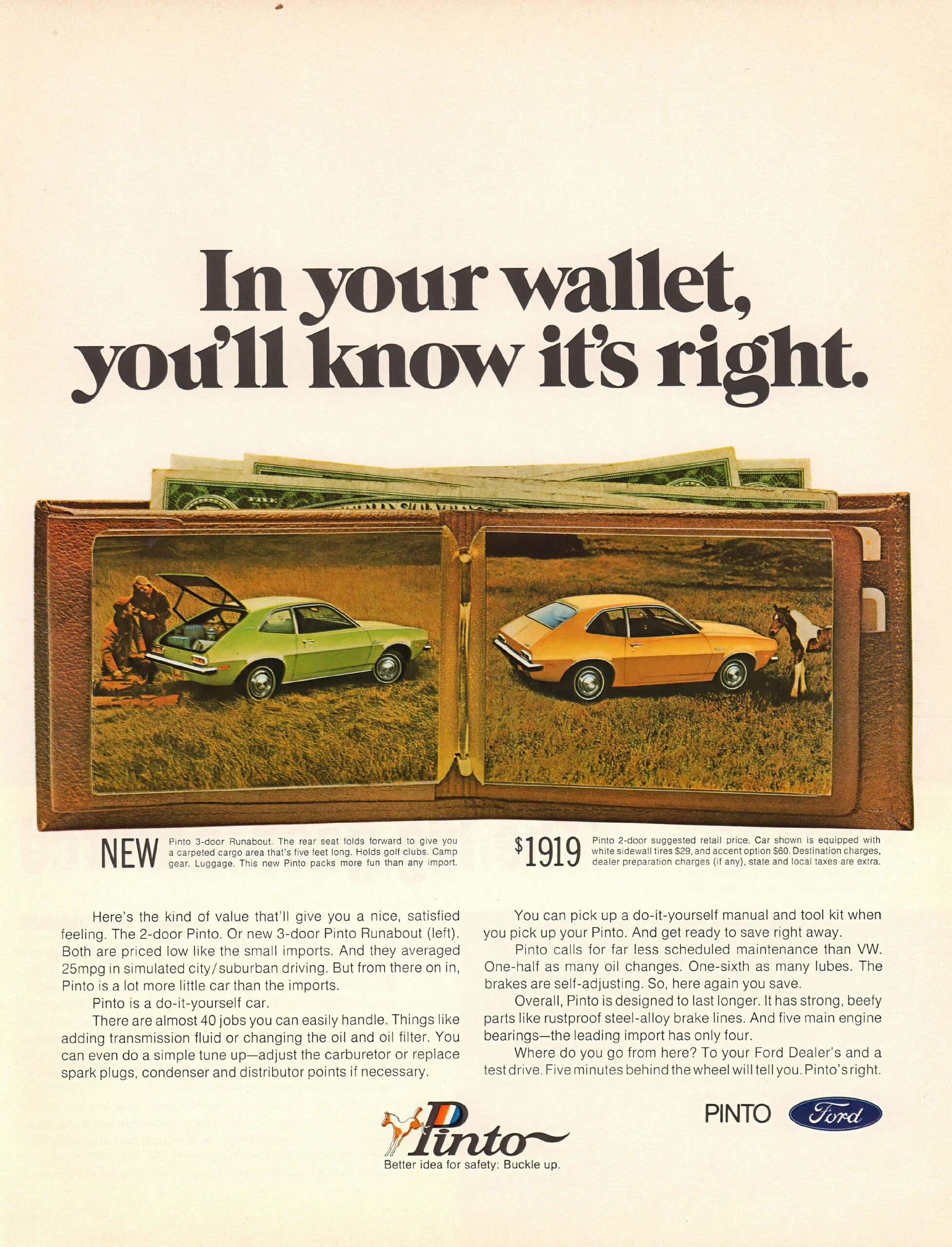
On September 11, 1970, Ford Motor Company introduced the Ford Pinto to the North American market under the marketing tagline “The Little Carefree Car.” Developed on a compressed roughly 25-month schedule, the new subcompact was intended to help Ford compete in the rapidly growing market for economical small cars, including imported models.
The Pinto initially became a commercial success. Ford targeted a curb weight below 2,000 pounds and a base price below $2,000, and the car incorporated features such as rack-and-pinion steering. Yet its development later became closely associated with a serious fuel-system safety controversy. In certain rear-end crashes, the fuel tank and filler-pipe assembly in 1971–76 Pintos could be damaged, creating a risk of fuel leakage and fire. Critics focused particularly on the tank’s placement behind the rear axle and its vulnerability to contact with surrounding rear-end components during a collision.
The issue generated extensive litigation, public criticism, and media scrutiny. The Center for Auto Safety had petitioned the National Highway Traffic Safety Administration to investigate the Pinto as early as 1974, and NHTSA ultimately determined in 1978 that the relevant fuel-system design presented a safety-related defect. Ford agreed on June 9, 1978, to recall approximately 1.5 million 1971–76 Pintos and about 30,000 Mercury Bobcats for fuel-system modifications intended to reduce leakage and fire risk in rear impacts.
The Pinto controversy remains a prominent case study in corporate ethics, product-safety engineering, consumer protection, and product liability. Although it was not the sole force behind changing automotive-safety expectations, the episode helped make crashworthiness and corporate decision-making central subjects in public discussion of automobile design.
Image: Ford Pinto advertisement from 1971 via Alamy
