
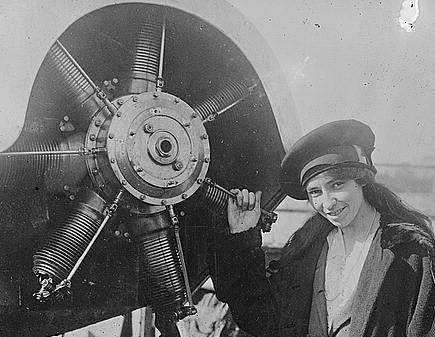
On September 3, 1917, pioneering American aviator Katherine Stinson returned to Japan during a landmark year in which her flights helped make her one of the best-known women in aviation. Earlier in 1917, following an exhibition tour that began in late 1916, Stinson became the first woman to fly in both Japan and China—an extraordinary achievement in the still-young age of powered flight.
Already famous in the United States as the fourth woman to receive a pilot’s license, Stinson captivated international crowds with daring loop-the-loops, nighttime flying displays lit by magnesium flares, and her confident technical command of the aircraft. Her exhibitions in Japan drew huge audiences; one Tokyo appearance attracted an estimated 25,000 spectators. Known by admirers as the “Air Queen” and the “Empress of the Air,” she gave audiences across East Asia a powerful public example of a woman mastering a demanding new technology.
Her international success had a larger significance than spectacle. At a time when women were routinely excluded from technical and professional fields, Stinson’s flying challenged conventional expectations about women’s abilities. She also left a lasting mark on American aviation: she became the first woman authorized to carry U.S. airmail and, later in 1917, set a U.S. nonstop distance-and-duration record with a 610-mile flight from San Diego to San Francisco.
Stinson’s wartime efforts made her story even more remarkable. After the United States entered World War I, she sought to serve as a military pilot but was rejected because she was a woman. Rather than abandon the effort, she used her celebrity and aircraft to raise support for the American Red Cross. In June 1917, her Buffalo-to-Washington flying campaign generated more than $2 million in Red Cross pledges. She later traveled to France to serve with the Red Cross ambulance service, arriving in October 1918.
Image: Katherine Stinson in Japan, via Wikimedia Commons, public domain
