
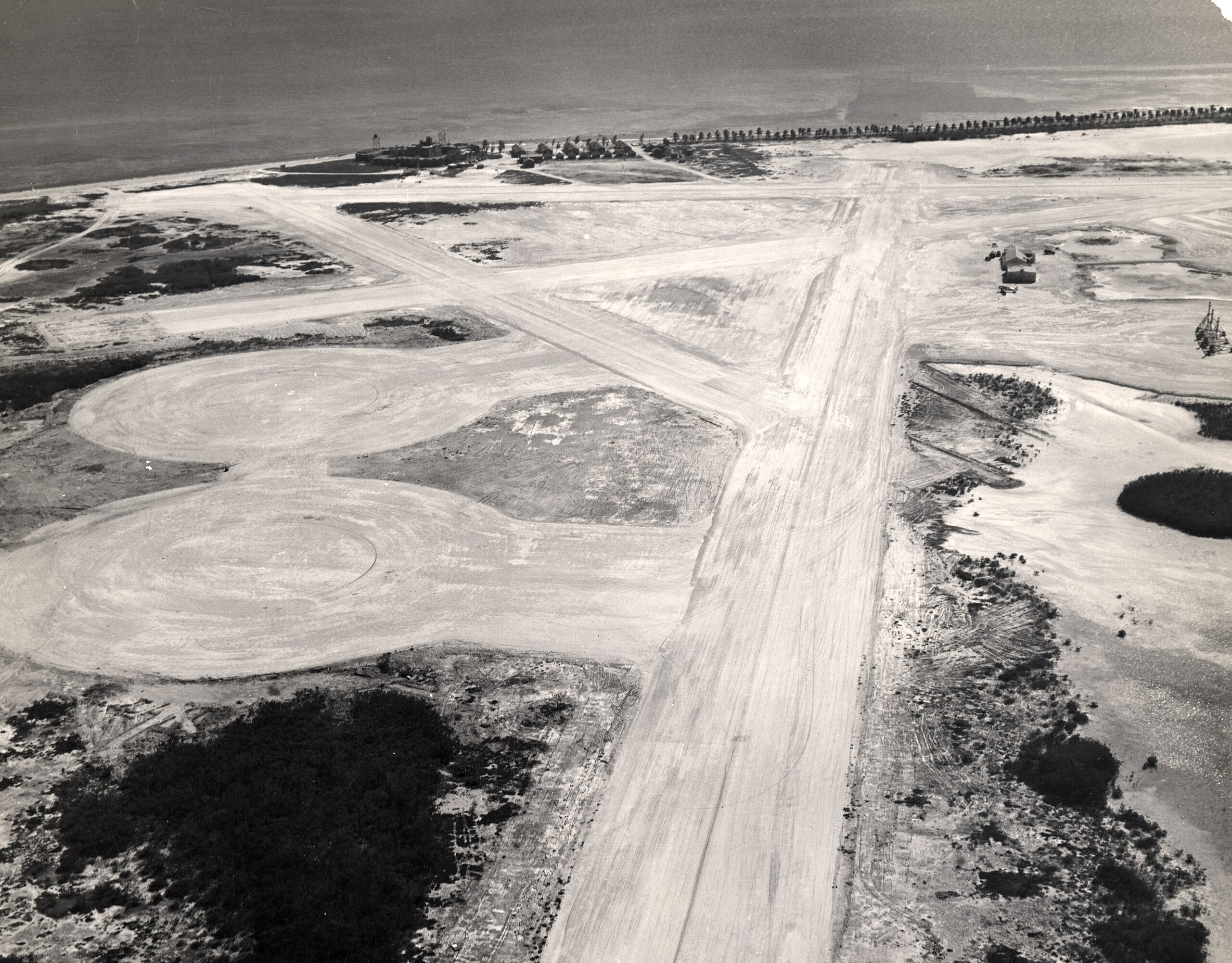
On October 3, 1945, a U.S. Navy aerial photograph recorded Meacham Field in Key West, Florida, looking south across its intersecting runways. Taken only weeks after Japan’s formal surrender ended World War II, the image captures the airfield at a moment of transition: its wartime military role was ending, while its future as a civilian airport was beginning.
Built on the southeastern edge of Key West amid mangrove swamp and salt-water ponds, Meacham Field developed from an earlier Pan American airfield into a wartime auxiliary installation. Its four hard-surfaced runways were described in contemporary base-history material as rolled marl, with coral rock crushed and rolled to create a durable surface. The field served as a satellite of Naval Air Station Key West, supporting naval flight training, carrier-aircraft bounce drills, and refueling operations. It had no regular heavier-than-air maintenance or repair facilities.
Meacham also supported lighter-than-air operations. Its facilities included blimp mooring circles, built to accommodate patrol and training activity connected with the Navy’s anti-submarine mission in the Florida Straits and Caribbean approaches. The Navy’s own regional history notes that Meacham—now Key West International Airport—supported blimps flying anti-submarine patrols.
The photograph is therefore more than a view of an airfield. It preserves a landscape reshaped for war: a compact network of runways and airship infrastructure imposed on Key West’s low, wet coastal terrain. After the war, control returned to the City of Key West, and the facility became Key West Municipal Airport. In January 1953, the city transferred title to Monroe County, allowing the county to seek federal aviation grants; around that time, the airport took the name Key West International Airport.
Photo credit: U.S. Navy, “Runways at Meacham Field looking south on October 3, 1945,” via Wikimedia Commons. Public domain.
