
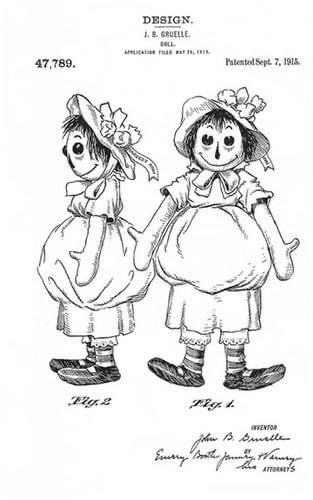
On September 7, 1915, American illustrator, cartoonist, and author Johnny Gruelle received U.S. Design Patent D47,789 for an ornamental doll design that became associated with Raggedy Ann. Filed on May 28 of that year, the 14-year design patent documented the distinctive cloth-doll form that would help establish one of America’s most recognizable children’s characters.
Raggedy Ann’s origin is closely linked to Gruelle’s daughter, Marcella, and to an old handmade rag doll. Family recollections describe Gruelle finding and reimagining such a doll, while Marcella’s play and the stories he told her helped shape the character. Because accounts of the doll’s discovery vary, it is safest to regard Marcella as a central inspiration rather than to present one version of the story as definitive.
Gruelle expanded the doll into literature with Raggedy Ann Stories, published by P. F. Volland in 1918. Written and illustrated by Gruelle, the book introduced Raggedy Ann’s world of animated toys and gentle moral lessons centered on affection, kindness, and imagination. Its release was paired with Raggedy Ann dolls, making the character an early and notably successful example of a children’s-book-and-toy tie-in.
The franchise grew with Raggedy Andy Stories and the Raggedy Andy doll in 1920. Over the following decades, Raggedy Ann and Andy became durable fixtures of American childhood culture, remembered not only as toys but also as storybook figures whose simple cloth construction and red-yarn hair became instantly recognizable visual icons.
Image via Wikimedia Commons; public domain.
