
On September 9, 1791, the three federal commissioners appointed by President George Washington—Thomas Johnson, Daniel Carroll, and David Stuart—formally designated the new federal city along the Potomac as the City of Washington. At the same time, they adopted “Territory of Columbia” for the larger federal district. The name honored the sitting president, whose leadership in the Revolutionary War and central role in the nation’s founding had made him the republic’s most prominent public figure.
The designation came amid the difficult practical work of creating a capital from privately held farmland. To carry out Pierre Charles L’Enfant’s grid-and-avenue plan, federal officials negotiated with local proprietors to place their land into the new city’s development scheme. Rather than simply purchasing every tract outright, the arrangement divided the resulting building lots between the public and the original owners, while compensating proprietors for land set aside for public buildings and squares.
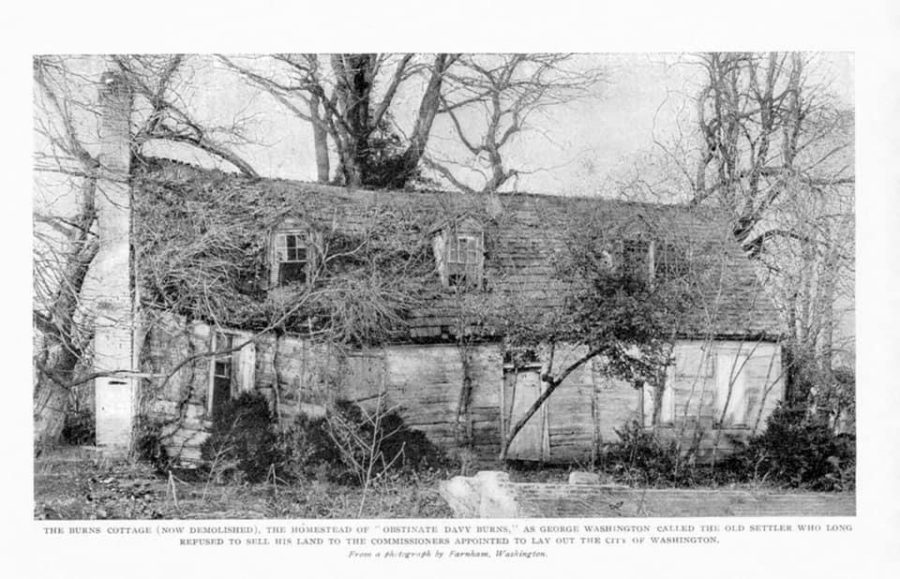
Among the best-known proprietors was David Burnes, often remembered as “the obstinate Mr. Burnes” for his resistance during negotiations. His holdings covered land that would become part of the city’s core, including areas near present-day Pennsylvania Avenue and the White House. Although he ultimately joined the 1791 agreement, Burnes secured protections for his home, and his relationship with the commissioners remained contentious.
Naming the federal city for Washington gave the new capital both a geographic identity and a powerful political symbol. The decision linked the planned seat of government to the nation’s most revered living figure, even as surveyors, landowners, laborers, and officials began the far less ceremonial work of turning the Potomac site into a functioning capital.
Image: The Burnes Cottage, home of Washington proprietor David Burnes, photographed in the late nineteenth century. Via Wikimedia Commons, public domain.
