
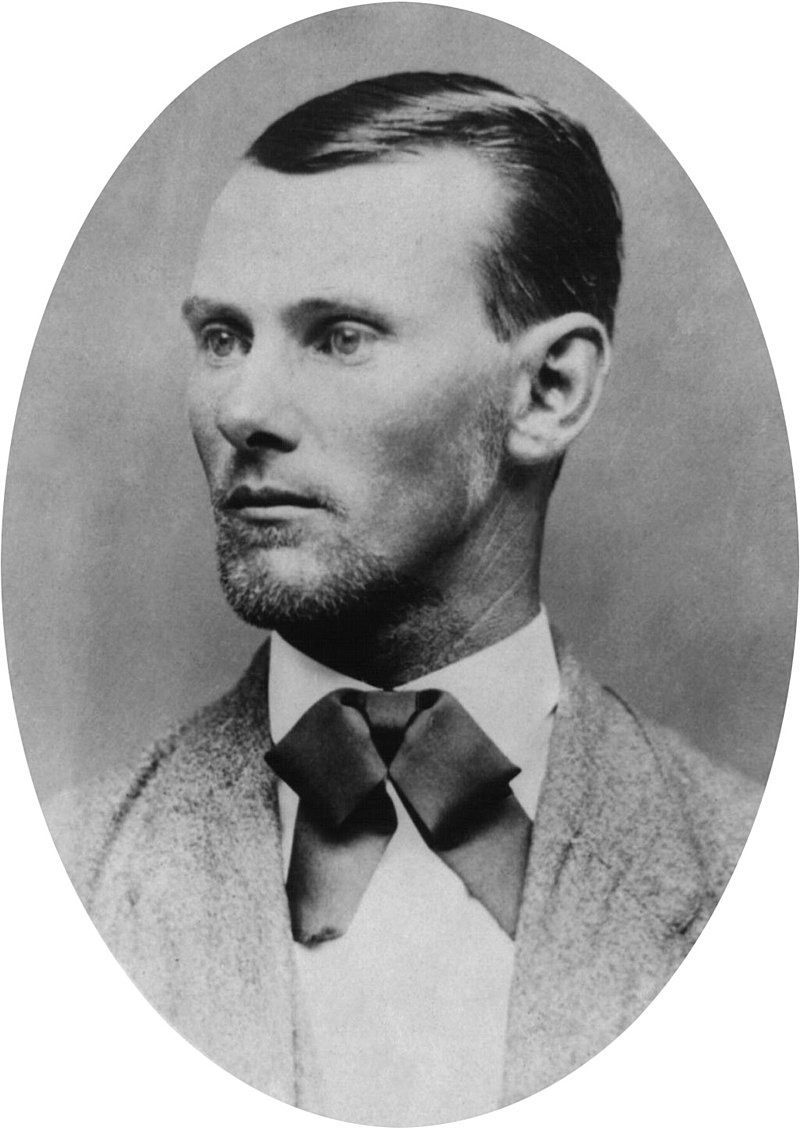
On September 5, 1847, Jesse Woodson James was born in Clay County, Missouri. Alongside his older brother Frank and the Younger brothers, James became the most famous member of the James–Younger Gang, which carried out a violent series of bank, train, and stagecoach robberies across Missouri and neighboring states in the years after the Civil War. His crimes captivated a country still divided by the conflict and made him one of the most recognizable—and polarizing—figures of the postwar era.
During his lifetime, James’s public image was carefully romanticized by pro-Confederate writers, especially John Newman Edwards, editor of the Kansas City Times. Edwards portrayed James as a persecuted Southern hero: a latter-day Robin Hood driven to outlawry by harsh Union and Republican authority, who supposedly struck at powerful railroads on behalf of impoverished white Southerners. That narrative resonated in a region shaped by the political upheaval, racial violence, and economic dislocation of Reconstruction. It also created a folk-hero image that endured long after James’s death.
The historical record, however, is far darker than the legend. As a teenager, James fought with Confederate guerrillas associated with William Quantrill and “Bloody Bill” Anderson. He participated in the violence surrounding the Centralia Massacre of 1864, when guerrillas murdered unarmed Union soldiers and mutilated bodies after the attack.
After the war, the James–Younger Gang’s robberies brought more deaths, including killings of bank employees, guards, and bystanders. James’s crimes were not acts of redistributive justice; they were rooted in the brutal political culture of wartime guerrilla conflict, personal enrichment, and continued resistance to the postwar order. Some historians also emphasize the political dimension of his outlaw career, viewing him as an active symbol—and agent—of unreconstructed Confederate resentment rather than merely a common criminal.
James’s violent career ended on April 3, 1882, when fellow gang member Robert Ford shot him in the back of the head at James’s home in St. Joseph, Missouri. The killing ended his life, but not the mythology surrounding it.
Image: Library of Congress, via Wikimedia Commons. Public domain.
