
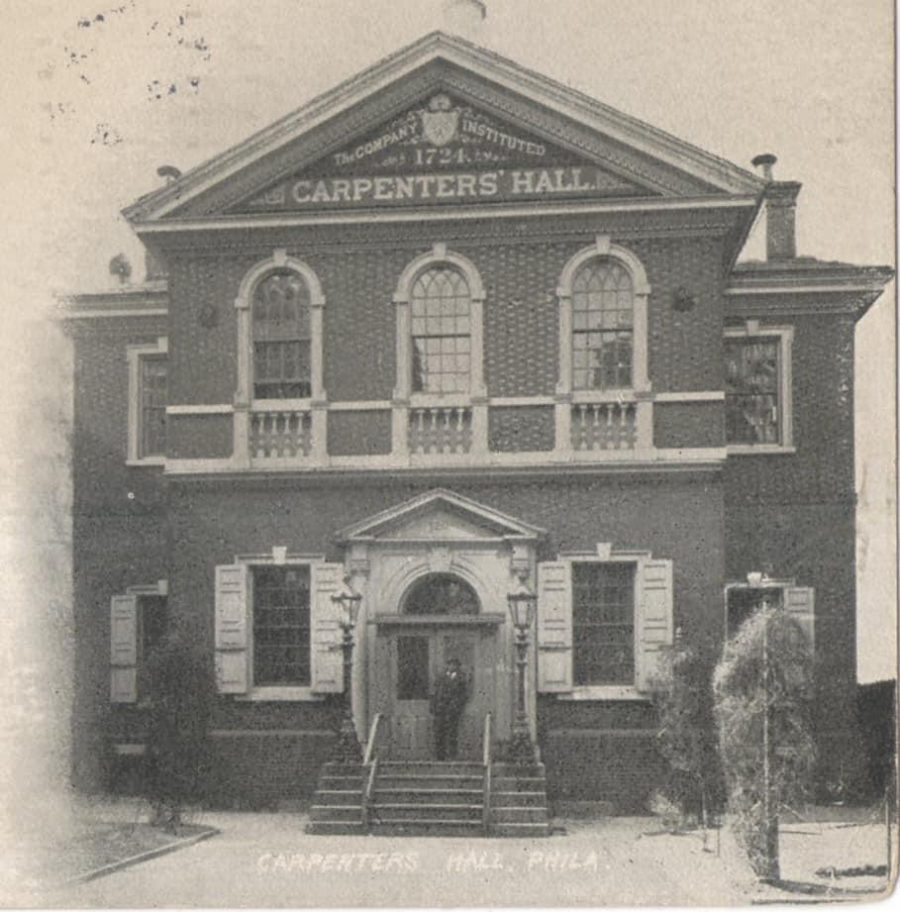
On September 5, 1774, delegates from twelve of Britain’s thirteen North American colonies gathered at Carpenters’ Hall in Philadelphia, opening the First Continental Congress. Convened in response to Parliament’s punitive Coercive Acts—known in the colonies as the Intolerable Acts—the assembly ultimately included 55 delegates, among them George Washington, John Adams, Samuel Adams, and Patrick Henry. From September 5 to October 26, they debated colonial rights, intercolonial unity, economic resistance, and the increasingly fraught relationship between the colonies and Great Britain.
The choice of Carpenters’ Hall carried political and symbolic weight. Instead of meeting in the Pennsylvania State House, now Independence Hall, the delegates chose the newly completed hall of the Carpenters’ Company of Philadelphia. Contemporary accounts indicate that the State House was proposed but rejected; Carpenters’ Hall offered more neutral ground and a setting less tied to Pennsylvania’s established political leadership. There, representatives from colonies with distinct local interests increasingly framed their grievances as a shared continental cause.
The Congress produced the Declaration and Resolves, setting out colonists’ claimed rights and condemning measures Parliament had imposed. It also adopted the Continental Association, an agreement for non-importation, non-consumption, and eventually non-exportation measures against British trade. Local committees were expected to help enforce the agreement, turning economic resistance into an organized, colony-wide political effort. The delegates further agreed to meet again in May 1775 if their grievances remained unresolved.
The First Continental Congress did not yet declare independence; its members still petitioned the king and presented their actions as efforts to restore their constitutional rights within the British Empire. Yet it established an enduring precedent: the colonies could act together through representative institutions. That precedent shaped the Second Continental Congress and, amid the escalation of war, helped make independence possible.
Image: A 1905 postcard view of Carpenters’ Hall, via Wikimedia Commons (public domain)
