
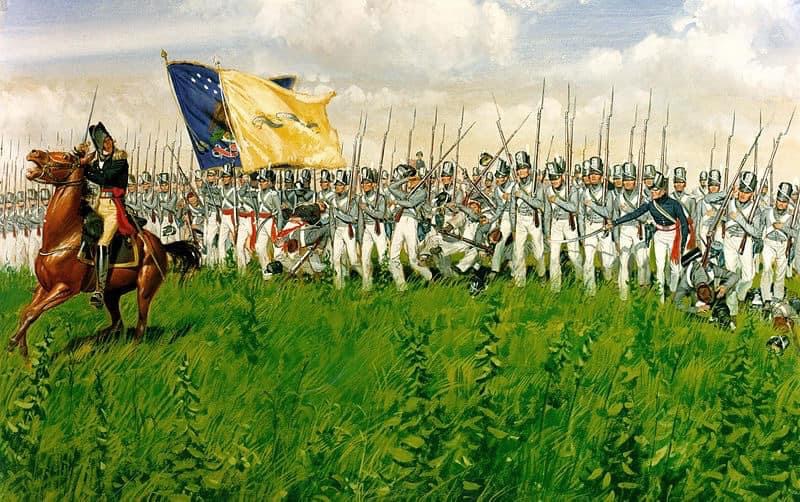
On July 5, 1814, during a critical phase of the War of 1812, British General Phineas Riall prepared his forces to engage an approaching line of American soldiers near the Niagara River at the Battle of Chippewa in Canada. Observing the smooth, unfazed advance of the American troops through a spyglass, Riall naively assumed he was opposing an inexperienced, easily routed force of local frontier militia. However, as he witnessed the American lines steadily maneuver, close ranks, and march forward with flawless precision directly through a devastating hail of heavy British artillery fire, Riall famously exclaimed in shock, “Those are Regulars, by God!” moments before his veteran British ranks were decisively broken and forced into a full retreat.
The hidden reason behind the British general’s costly tactical confusion stemmed directly from a severe, wartime supply shortage regarding American military uniforms. Brigadier General Winfield Scott had spent months intensely drilling his regular soldiers into a highly disciplined combat force, but the U.S. Army was entirely incapable of securing standard-issue blue wool coats for his regiments. Out of pure necessity, Scott was forced to outfit his highly trained regular troops in plain, unadorned grey cloth coats that were typically reserved for raw, untrained local militia units, inadvertently leading the overconfident British forces to march straight into a highly disciplined, professional trap.
The spectacular American victory at the Battle of Chippewa provided a massive, much-needed boost to national morale after years of embarrassing military defeats along the Canadian frontier, proving definitively that American soldiers could match the disciplined battlefield execution of Great Britain’s veteran professional army. In honor of Winfield Scott’s brilliant tactical leadership and the fierce bravery demonstrated by his grey-clad soldiers during the battle, the United States Military Academy at West Point later adopted the exact shade of grey for its official cadet uniforms. Today, that distinctive grey fabric remains an enduring, physical monument to the iron discipline displayed by those regular soldiers under fire on July 5, 1814.
Image from USACMH via Wikimedia Commons, public domain in the US
