
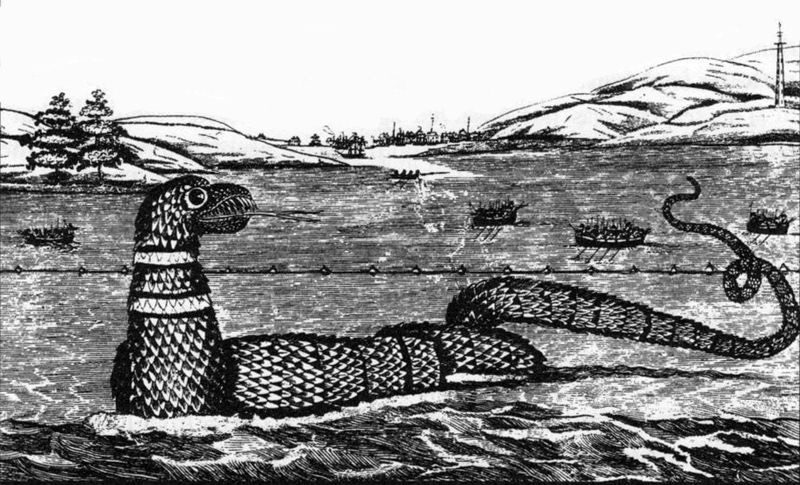
On August 18, 1817, a sea serpent sixty to seventy feet in length was reportedly seen off Gloucester, Massachusetts, by a number of witnesses. Repeated sightings of the mysterious creature occurred over the next two years. The sudden appearance of the colossus inside Gloucester Harbor triggered a massive wave of scientific curiosity and public excitement across early New England.
Dozens of highly respected citizens, including ship captains, merchants, and local fishermen, provided detailed, sworn affidavits to the Linnaean Society of New England. They described a smooth, multi-humped marine creature that moved through the waves with the velocity of a whale. The continuous stream of sightings transformed the quiet fishing village into a major destination for curious travelers, with crowds gathering along the rocky shoreline hoping to glimpse the creature.
The mystery took a frustrating turn when local hunters killed a strange, deformed black snake on a nearby beach, leading well-intentioned scientists to mistakenly classify it as the newborn offspring of the great sea serpent. When subsequent anatomical examinations proved the small specimen was merely a common, diseased black snake, the scientific community faced public ridicule, casting a shadow of doubt over the original eyewitness accounts. Despite the lack of physical proof, the documented encounters of August 1817 remain one of the most thoroughly recorded and tantalizing cryptozoological enigmas in early American maritime history.
Image: The Gloucester Sea Serpent engraving via Wikimedia Commons, public domain in the US
