
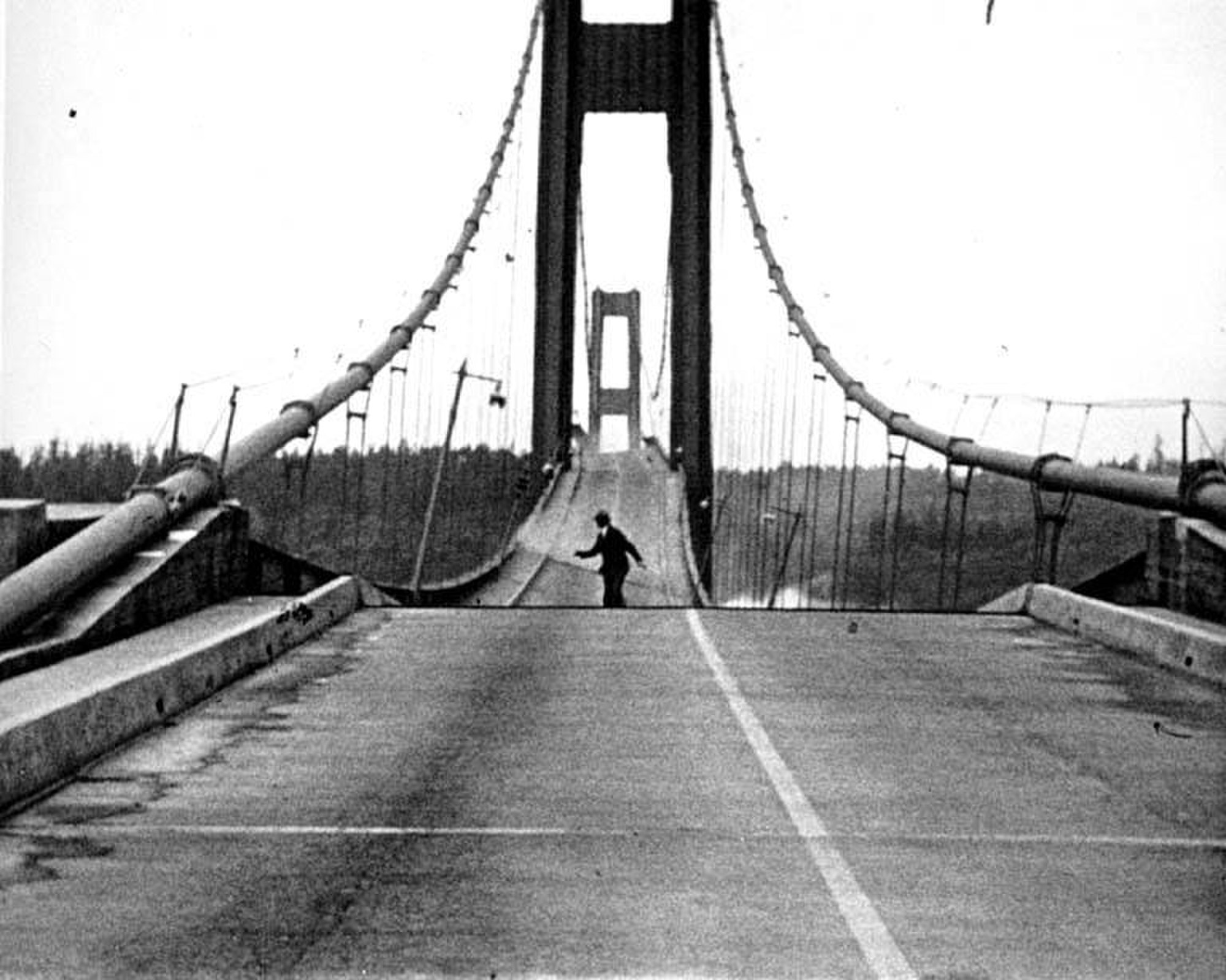
On the morning of November 7, 1940, the four-month-old Tacoma Narrows Bridge in Washington State collapsed into Puget Sound in winds of about forty-two miles per hour. Known as “Galloping Gertie” for the rolling movements of its roadway, the suspension bridge had displayed unsettling flexibility almost from the time it opened. That morning, its familiar vertical undulations gave way to violent twisting, with the roadway tilting as much as forty-five degrees. Photographer Howard Clifford was among those who scrambled to safety before sections of the central span broke apart and fell into the water.
The failure exposed a dangerous gap in engineers’ understanding of how wind could interact with a slender, flexible bridge. Designed under Leon Moisseiff, the span used shallow, solid steel plate girders rather than deep, open stiffening trusses. Its vulnerability involved more than wind pressing against those solid sides: the deck’s aerodynamic shape and limited resistance to twisting allowed a destructive interaction known as aeroelastic flutter. As the roadway twisted, aerodynamic forces fed energy into its motion, amplifying the oscillations until the structure could no longer withstand them. Much of the central roadway collapsed, although the towers, main cables, side spans, and anchorages remained.
The collapse became a defining lesson in the importance of aerodynamic stability in suspension-bridge design. Engineers developing the replacement investigated the failure through model testing and adopted a substantially different structure. Completed in 1950, the new bridge featured deep, open steel trusses and wind grates that allowed freer airflow and reduced its tendency to twist. The enduring lesson of “Galloping Gertie” was not simply that bridges needed greater strength. Engineers also had to understand how a flexible structure and the moving air around it could act together—and how that interaction could turn ordinary winds into a destructive force.
