
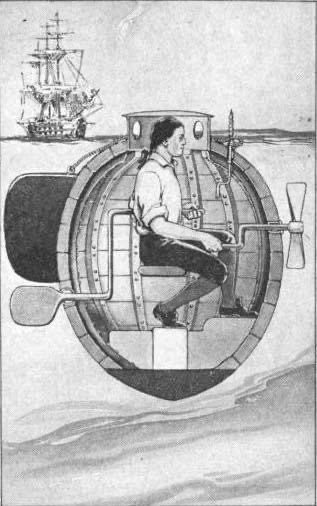
On the night of September 6–7, 1776, in the opening months of the American Revolution, naval warfare entered unfamiliar territory in New York Harbor. Under the direction of inventor David Bushnell, Continental Army sergeant Ezra Lee piloted Turtle, an experimental one-man submersible, in an attempt to destroy the British warship HMS Eagle. The operation is widely regarded as the first use of a submarine in warfare.
Turtle was a small, hand-powered wooden craft designed to approach enemy ships unseen and attach a timed gunpowder charge beneath their hulls. Alone inside its cramped interior, Lee used hand-cranked propellers for horizontal movement and foot-operated controls to manage depth as he fought the harbor’s currents and made his way toward the British flagship.
His target was HMS Eagle, a 64-gun ship serving as Admiral Richard Howe’s flagship. Lee succeeded in reaching the vessel and maneuvering beneath it. He then attempted to use Turtle’s boring screw to fasten the explosive charge to the ship’s underside. But the screw would not penetrate the hull. Later accounts attributed the failure to an iron bar or plate near the Eagle’s rudder hinge, though the precise obstruction cannot be known with certainty.
With daylight approaching, his air supply and stamina dwindling, and the danger of discovery increasing, Lee abandoned the effort. He released the charge as he escaped; it later exploded in the harbor without damaging HMS Eagle.
The mission did not achieve its immediate objective, but it established a powerful idea: a small underwater vessel could potentially threaten a much larger warship. Turtle did not revolutionize naval warfare overnight, yet Lee’s attempt marked a foundational moment in the long development of submarines and underwater warfare.
Image via Wikimedia Commons, public domain
