
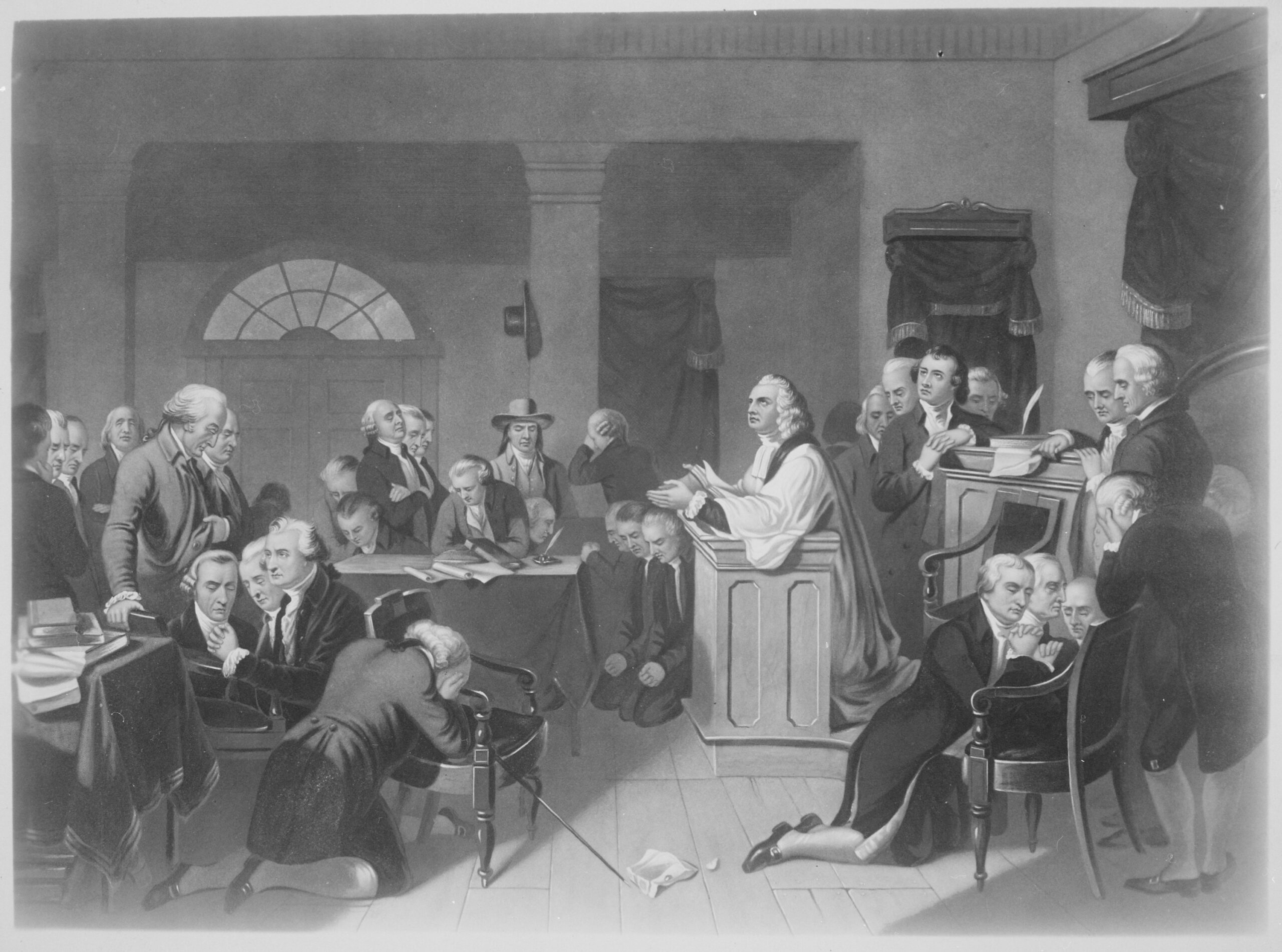
On September 7, 1774, the First Continental Congress gathered at Carpenters’ Hall in Philadelphia for its third day of deliberations. Before turning to the political crisis with Britain, the delegates opened the morning with prayer led by the Reverend Jacob Duché, rector of Christ Church.
The decision followed disturbing, unconfirmed reports of violence against Boston. In a later letter, John Adams recalled that Congress had heard a “horrible Rumour” the night before—news that helped lend urgency to the moment.
The proposal for common prayer initially encountered resistance. According to Adams, John Jay of New York and John Rutledge of South Carolina objected because the delegates came from differing religious traditions—Episcopalian, Quaker, Anabaptist, Presbyterian, and Congregationalist—and might not be able to “join in the same Act of Worship.” Samuel Adams answered that he was “no Bigot” and could hear a prayer from any man of piety and virtue who was also a friend to his country. Congress then invited Duché to lead the service.
Duché began with prayers from the Anglican liturgy and read the Psalm appointed for September 7, Psalm 35. He then departed from the expected form with an extemporaneous prayer for protection, wisdom, and unity. John Adams wrote that the prayer “filled the Bosom of every Man present” and had “an excellent Effect upon every Body.”
The episode did not erase the delegates’ profound political, regional, or religious differences. But it became an enduring symbol of an emerging continental cause: representatives from separate colonies, confronting imperial crisis together, seeking common purpose before beginning their work.
Image: “The First Prayer in Congress,” Library of Congress, public domain.
