
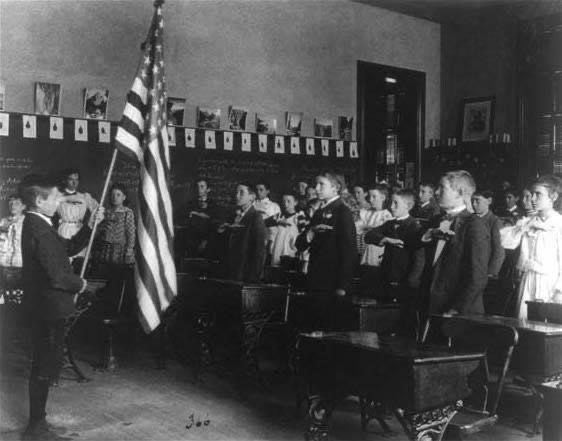
On September 8, 1892, The Youth’s Companion—a widely read national magazine—published the first version of what became the Pledge of Allegiance. Francis Bellamy, a Baptist minister, author, and Christian socialist who worked for the magazine, wrote the 23-word pledge as part of a campaign connected to the approaching 400th anniversary of Christopher Columbus’s arrival in the Americas.
The publication was part of a coordinated effort, led in part by Youth’s Companion executive James B. Upham, to promote a nationwide Columbus Day observance in public schools. Bellamy’s language was meant to be recited in unison by students, creating a shared civic ritual in a country experiencing rapid industrial expansion, post–Civil War change, and large-scale immigration.
The original pledge read: “I pledge allegiance to my Flag and to the Republic for which it stands—one Nation indivisible—with Liberty and Justice for all.”
Students were also instructed to use what later became known as the Bellamy salute, extending the right arm toward the flag. That gesture was replaced with the hand-over-heart salute in 1942 after it became visually associated with fascist and Nazi salutes.
The language of the Pledge later evolved: “my Flag” was replaced with “the Flag of the United States” in 1923, “of America” was added in 1924, Congress placed it in the federal Flag Code in 1942, and “under God” was added in 1954.
The 1892 printing remains an important moment in American civic history, illustrating how public schools, patriotic organizations, and mass media worked together to establish a widely shared national ritual.
Image: Students giving the flag salute, 1899. Photograph by Frances Benjamin Johnston, via Wikimedia Commons; public domain.
