
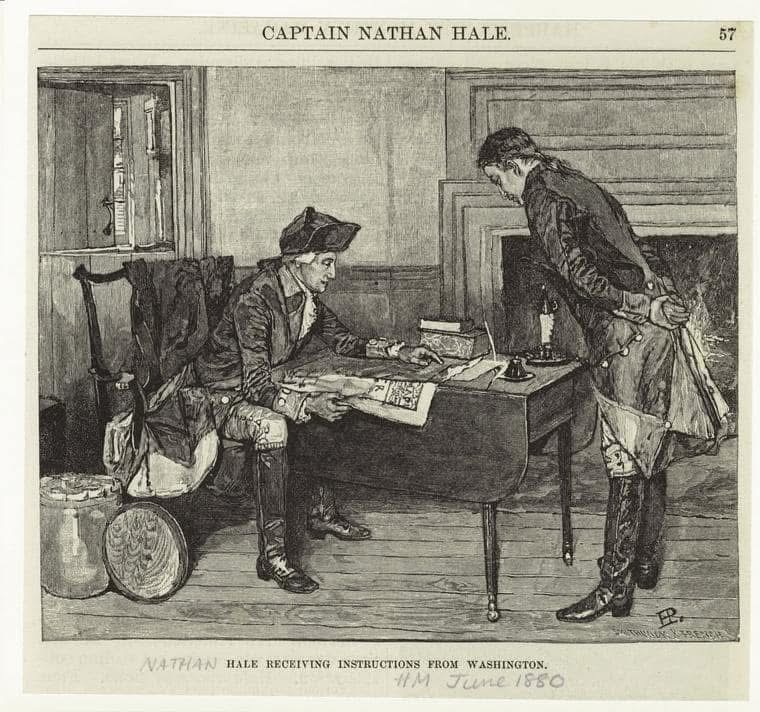
On September 8, 1776, twenty-one-year-old Captain Nathan Hale of the Continental Army volunteered for a dangerous intelligence mission behind British lines. Following the American defeat at the Battle of Long Island, General George Washington needed information about British troop positions, movements, and strength on Long Island and near Manhattan.
A Yale graduate and former schoolteacher, Hale understood the danger of the assignment. Captured spies were not generally afforded the protections given to ordinary prisoners of war and could be executed. Traveling in civilian clothing and posing as a schoolteacher seeking work, Hale crossed Long Island Sound from Norwalk, Connecticut, to British-controlled Long Island in mid-September. He was expected to observe and report on British forces, though the precise details of his movements and intelligence-gathering remain uncertain.
Hale was captured on September 21, 1776, after British forces discovered that he was an American officer operating behind their lines. Later accounts associate his capture with Major Robert Rogers and place it near Flushing Bay, but the exact circumstances are not fully documented. He was taken to British headquarters in New York City, where he admitted his mission. The following morning, September 22, he was hanged as a spy near the British artillery park.
Hale is remembered for the words traditionally attributed to him: “I only regret that I have but one life to lose for my country.” The quotation, likely inspired by Joseph Addison’s Cato, does not appear in a contemporary eyewitness record, but it became one of the Revolution’s most enduring expressions of patriotic sacrifice.
Image: Captain Nathan Hale receiving espionage instructions from General George Washington, New York Public Library Digital Collections; no known restrictions.
