
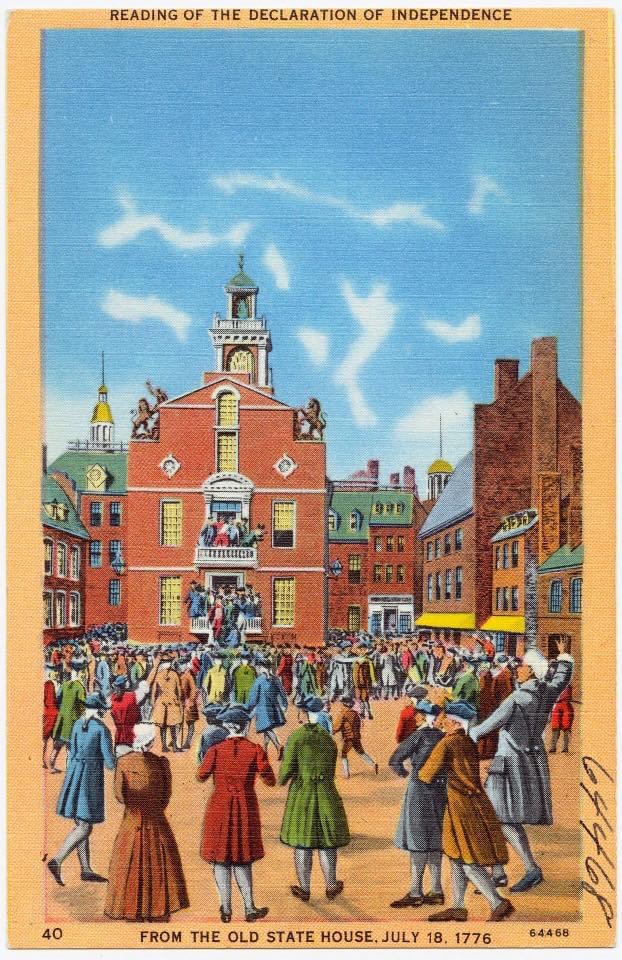
On July 18, 1776, a momentous chapter in the birth of the American republic unfolded in Massachusetts as the text of the newly declared Declaration of Independence was read aloud to the public for the first time in Boston. Town Clerk William Greenleaf began the reading from the balcony of the Old State House, but when his voice failed to carry over the roaring crowd, Colonel Thomas Crafts stepped forward and forcefully projected the words to the anxious, tightly packed audience below. The public reading transformed the abstract concepts of Philadelphia’s congress into a thrilling, local reality, sparking a wave of anti‑imperial celebration that swept through the heart of the city.
A hidden, dramatic layer of this Boston debut was the sudden, collective destruction of royal symbols that instantly followed the reading. As the final words of the proclamation echoed through the square, the jubilant crowd surged inside the Old State House, tearing down the ornate wooden lion and unicorn statues—the traditional symbols of British royal authority—that had long decorated the building’s roof. The citizens carried the imperial relics to a massive bonfire in the center of King Street, burning them to ashes along with every royal coat of arms and Tory shop sign they could find to visually purge the city of its colonial past on day one.
In the days that followed, Boston’s July 18 reading became a defining civic ritual, inspiring similar public proclamations across New England. Local committees encouraged residents to remove British crests from taverns, warehouses, and even private homes, arguing that independence required not only political separation but a cultural cleansing of imperial imagery. The balcony proclamation thus marked the moment Boston began actively reshaping its identity from a colonial capital into a revolutionary stronghold.
Image: Vintage postcard depicting the reading from the Old State House by Tichnor Bros. Inc., Boston, Mass. Public domain via Wikimedia Commons.
