
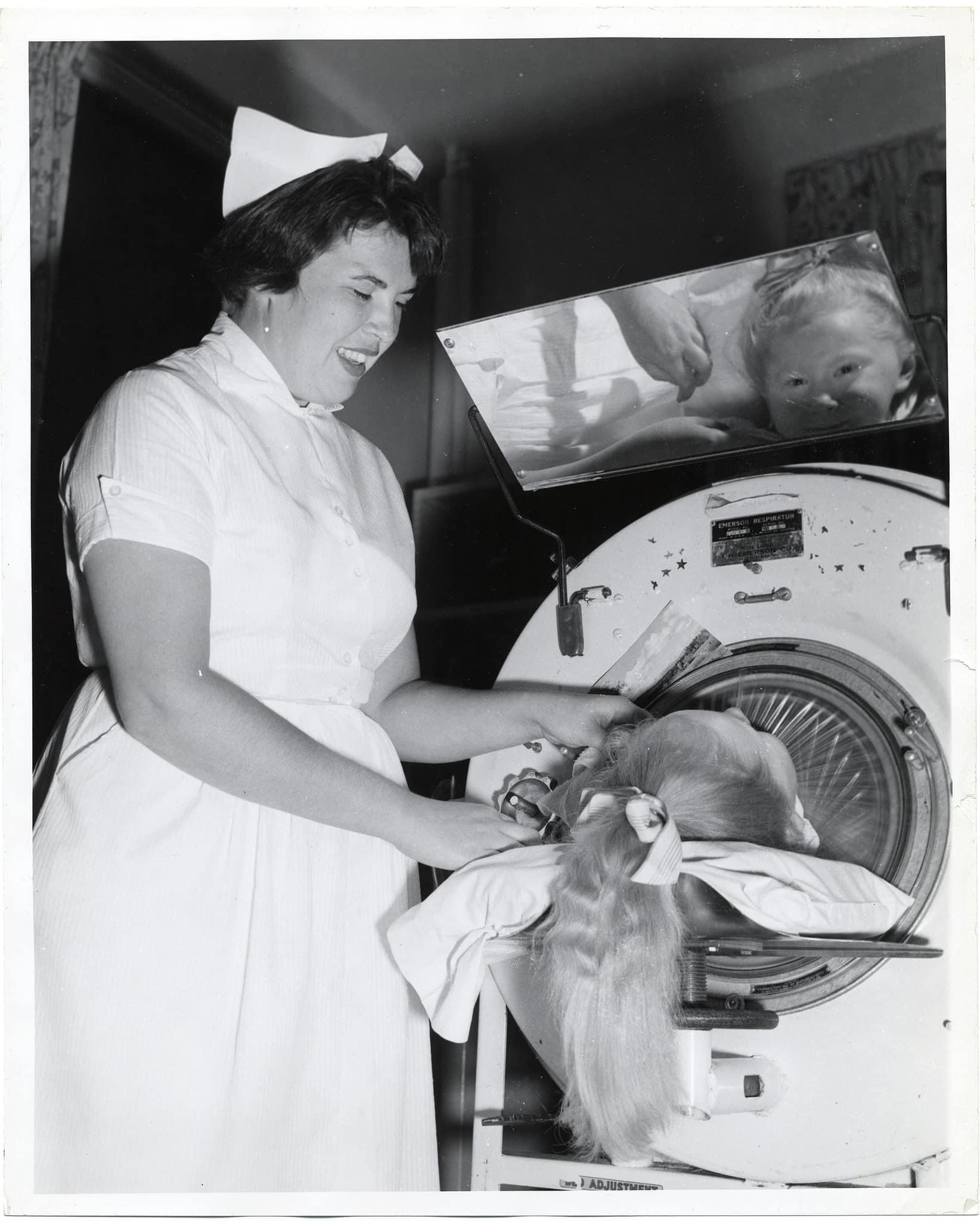
On October 12, 1928, a revolutionary medical device known as the Drinker and Shaw iron lung was used to treat a human patient for the first time at Boston Children’s Hospital. Invented by Harvard researchers Philip Drinker and Louis Agassiz Shaw, the large metal tank was brought into urgent service to help eight-year-old Bertha Richard, who was suffering respiratory paralysis from polio. The child was placed inside the airtight chamber with only her head exposed; changes in pressure around her body mechanically expanded and collapsed her lungs, allowing her to breathe.
The machine worked almost immediately. Within minutes, Bertha’s breathing improved dramatically; she was able to speak, sleep, and take nourishment while the respirator supported her for 122 hours. Although she ultimately died on October 19 from pneumonia and heart failure, the trial proved that mechanical ventilation could sustain a patient whose breathing muscles had been paralyzed by polio.
The Boston debut marked the beginning of modern negative-pressure mechanical ventilation. Refinements of the Drinker respirator soon became widely known as “iron lungs,” and they saved thousands of lives during the mid-20th-century polio epidemics.
The technology established an enduring legacy of comfort and survival for generations of polio patients. Decades later, long-term survivors frequently expressed a strong preference for the iron lung over modern positive-pressure ventilators, noting that its negative-pressure vacuum more naturally mimicked physiological breathing without forcing air down the trachea. This historic chapter of medical history drew to a definitive close following the passings of the world’s final long-term users, Paul Alexander in March 2024 and Martha Lillard in June 2026, leaving the iconic steel cylinders as revered symbols of clinical resilience and technological innovation.
Photo Caption: An early 1930s patient lies inside the Drinker and Shaw negative-pressure respirator, with only their head exposed, while a nurse adjusts the airtight collar. Following the machine’s historic inaugural clinical deployment on October 12, 1928, at Boston Children’s Hospital, these large steel cylinders—popularly dubbed “iron lungs”—became a defining symbol of medical resilience, mechanically altering air pressure to sustain thousands of paralyzed children during the height of the mid-century polio epidemics.
