
Born on November 13, 1833, near Bel Air, Maryland, Edwin Thomas Booth became one of nineteenth-century America’s foremost Shakespearean actors, celebrated especially for his portrayal of Hamlet. Raised in the theatrical dynasty of his father, Junius Brutus Booth, Edwin developed a style distinguished by its sensitivity and restraint, offering a quieter alternative to the forceful declamation common on the contemporary stage. His reputation extended beyond the United States to European audiences, establishing him as an important interpreter of Shakespeare.
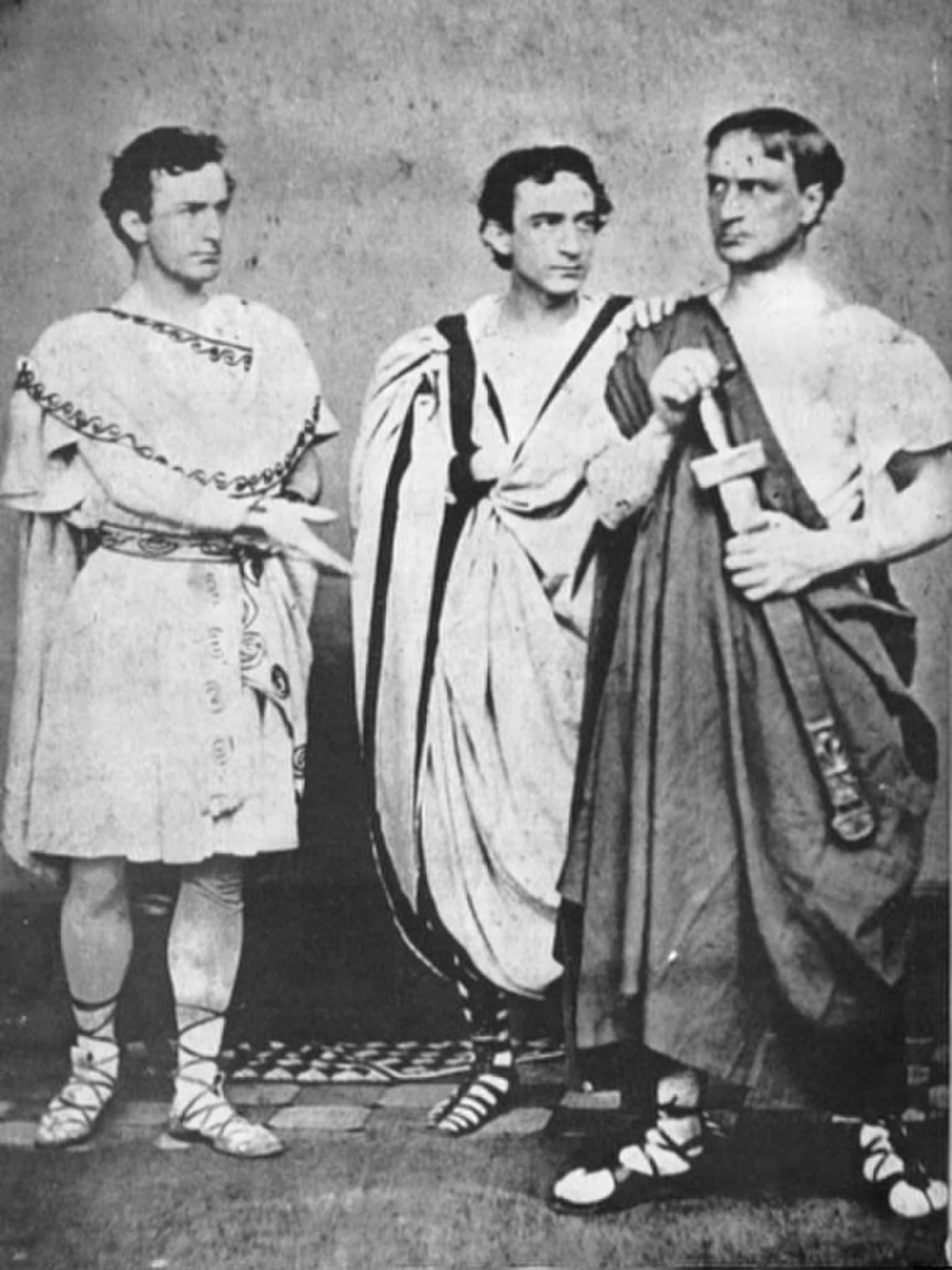
On November 25, 1864, Edwin appeared alongside his brothers, Junius Brutus Booth Jr. and John Wilkes Booth, in a benefit performance of Julius Caesar at New York’s Winter Garden Theatre. Edwin played Brutus, Junius played Cassius, and John Wilkes played Mark Antony. The performance raised money for a Shakespeare monument and marked the only time the three brothers appeared together onstage. A surviving photograph shows them in costume—a theatrical family portrait made haunting by what followed.
Less than five months later, John Wilkes Booth shot President Abraham Lincoln at Ford’s Theatre on April 14, 1865. Devastated by the assassination, Edwin withdrew from the stage and declared that he would not perform again. His connection to the Lincoln family, however, held an extraordinary contrast: before the assassination, he had rescued the president’s eldest son, Robert Todd Lincoln, from serious injury or possible death at a railway station in Jersey City. When Robert fell into the gap between a platform and a moving train, Edwin seized his coat collar and pulled him to safety. The encounter’s exact date remains uncertain, although Robert recalled it as occurring in 1863 or 1864.
Edwin returned to the Winter Garden as Hamlet in January 1866, resuming a career that would secure his place in American theatrical history. In 1888, he founded The Players in New York City, creating a gathering place where actors could meet writers, artists, and members of other professions. The institution gave lasting form to his commitment to theater as part of the nation’s wider cultural life.
His life resists being reduced to the shadow of his brother’s crime. While John Wilkes Booth became inseparable from Lincoln’s assassination, Edwin left a different inheritance: distinguished performances, an enduring institution, and a career that helped define the possibilities of Shakespearean acting in America.
