
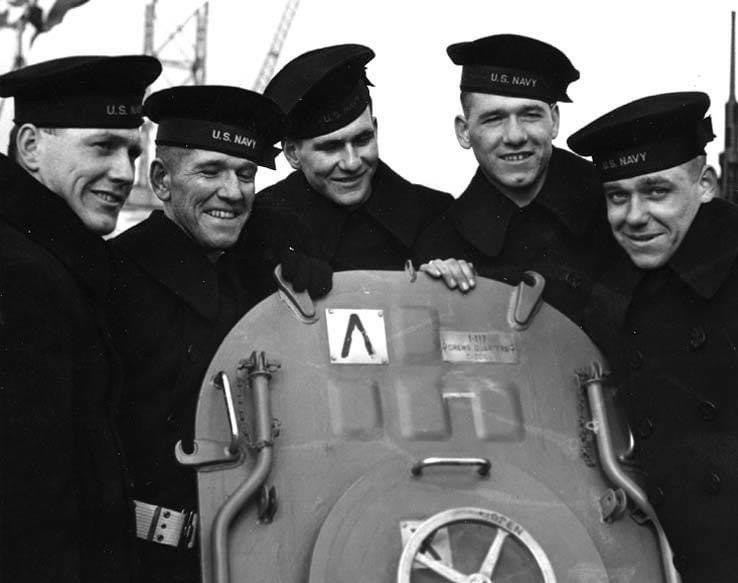
On November 13, 1942, the U.S. Navy light cruiser USS Juneau was withdrawing from the Naval Battle of Guadalcanal after suffering a torpedo hit during the night’s fighting. Later that morning, a second torpedo, fired by the Japanese submarine I-26, struck the damaged cruiser. A catastrophic explosion broke the ship apart, and she disappeared in seconds. Among those who died as a result of the sinking were George, Francis, Joseph, Madison, and Albert Sullivan—five brothers from Waterloo, Iowa, who had enlisted together and successfully requested assignment to the same ship.
Fearing further submarine attacks and believing that almost no one could have survived the explosion, the accompanying American warships continued their withdrawal without conducting an immediate search. Yet an estimated 140 men had initially survived. In the days that followed, exposure, exhaustion, and shark attacks devastated their numbers. Only ten men who had been aboard when Juneau sank ultimately survived, with rescues taking place on November 19 and 20. George Sullivan is believed to have survived the initial sinking but died before help arrived; none of his brothers returned.
The deaths of all five brothers became a national symbol of wartime sacrifice. President Franklin D. Roosevelt sent a personal letter of condolence to their parents, Thomas and Alleta Sullivan. In the months that followed, the family carried its grief into public service, visiting shipyards and war plants to encourage workers supporting the war effort. The Navy honored the brothers by naming a destroyer USS The Sullivans. Their mother sponsored the ship at its launching on April 4, 1943; it entered commission on September 30 that year.
The tragedy also became closely associated with questions about family members serving together, although its policy legacy is often overstated. The Navy had already discouraged assigning brothers to the same ship before Juneau was lost. Afterward, it considered—but did not adopt—compulsory separation. The sinking therefore did not create a blanket ban on siblings serving together.
In 1944, the War Department and Navy introduced policies protecting surviving sons of families that had suffered multiple wartime deaths; the Navy broadened its provisions the following year. The Sullivan brothers’ story belongs within that larger history, rather than serving as a simple explanation for a single policy change. Their photograph, taken aboard Juneau in February 1942, preserves the five together near the beginning of their service—a lasting image of the family behind the national tragedy.
