
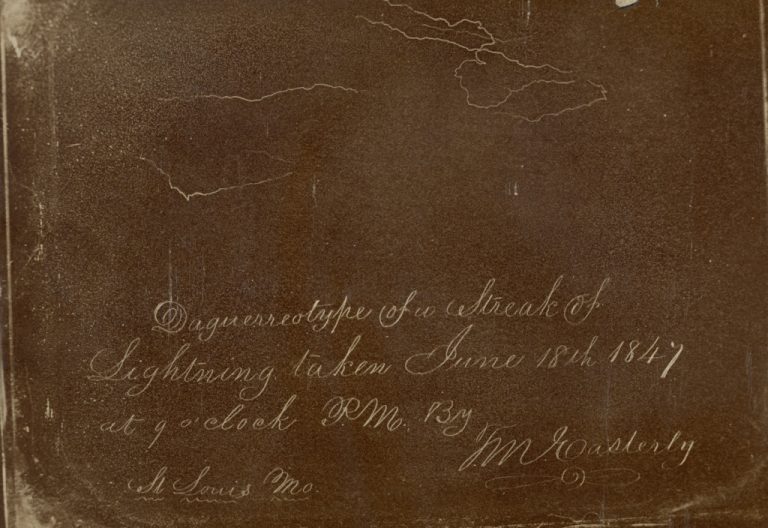
What appears to be an amber plate with words and scratches on it is actually something much more: a surviving echo of the first successful photograph of lightning ever taken. In June of 1847, St. Louis daguerreotypist Thomas M. Easterly aimed his camera into a stormy Midwestern night and captured a single electric bolt as it tore across the sky. The original plate—long since lost—was later copied by the St. Louis firm Cramer, Gross & Co., whose cabinet card reproduction is now preserved at the Missouri History Museum. What looks like damage, streaking, or chemical abrasion is in fact the raw, metallic record of a moment no human eye could have frozen.
Seen today, the image feels almost abstract: a jagged white incision against a dark, reddish field, as if nature had scratched its signature directly onto the metal. But Easterly’s experiment was far from accidental. At a time when night photography was nearly impossible and exposure times stretched into minutes, he managed to trap a millisecond of atmospheric violence on a daguerreotype plate. This cabinet card is more than a copy—it is a testament to early American photographic daring, and to the strange beauty of a storm caught in silver.
