
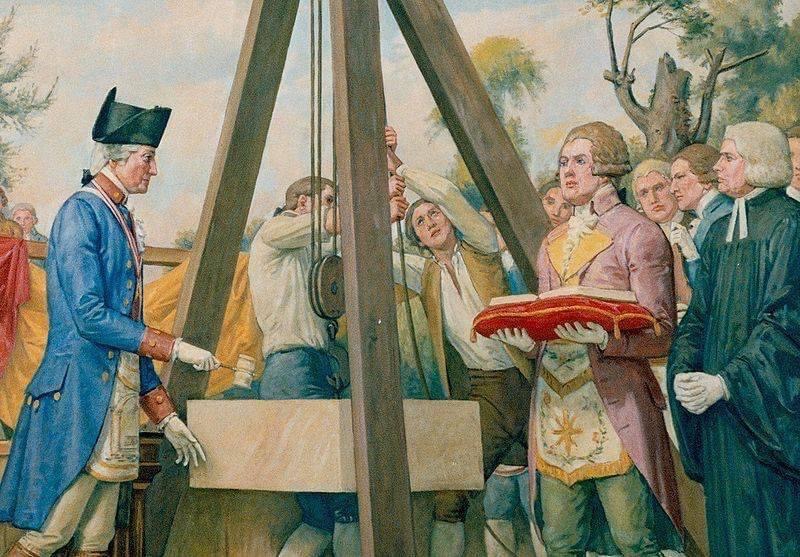
On September 18, 1793, President George Washington traveled to the developing federal city to lay the cornerstone of the United States Capitol. The elaborate Masonic ceremony marked a defining moment in the creation of a permanent, purpose-built home for Congress in the new national capital on the Potomac River.
Wearing Masonic regalia, Washington joined a large civic procession at Capitol Hill, accompanied by fellow Masons, military companies, musicians, and local dignitaries. He placed an inscribed silver plate beneath the stone and formally laid the cornerstone at the building’s southeast corner. The occasion was among the first major public ceremonies held in the new federal city.
The Capitol’s plan had been submitted by Dr. William Thornton and approved by Washington earlier that year. Washington praised the design for its “grandeur, simplicity and convenience.” Thornton’s neoclassical vision—featuring a central section and separate wings for the Senate and House—was intended to give architectural expression to the aspirations of the new republic.
The ceremony represented more than the start of a building project. It gave physical form to the decision to establish a permanent federal government in the District of Columbia and began the long construction history of the institution that would become the enduring home and public symbol of the legislative branch.
On September 18, 1793, President George Washington laid the cornerstone of the U.S. Capitol during a Masonic ceremony. Image via Wikimedia Commons, public domain.
