
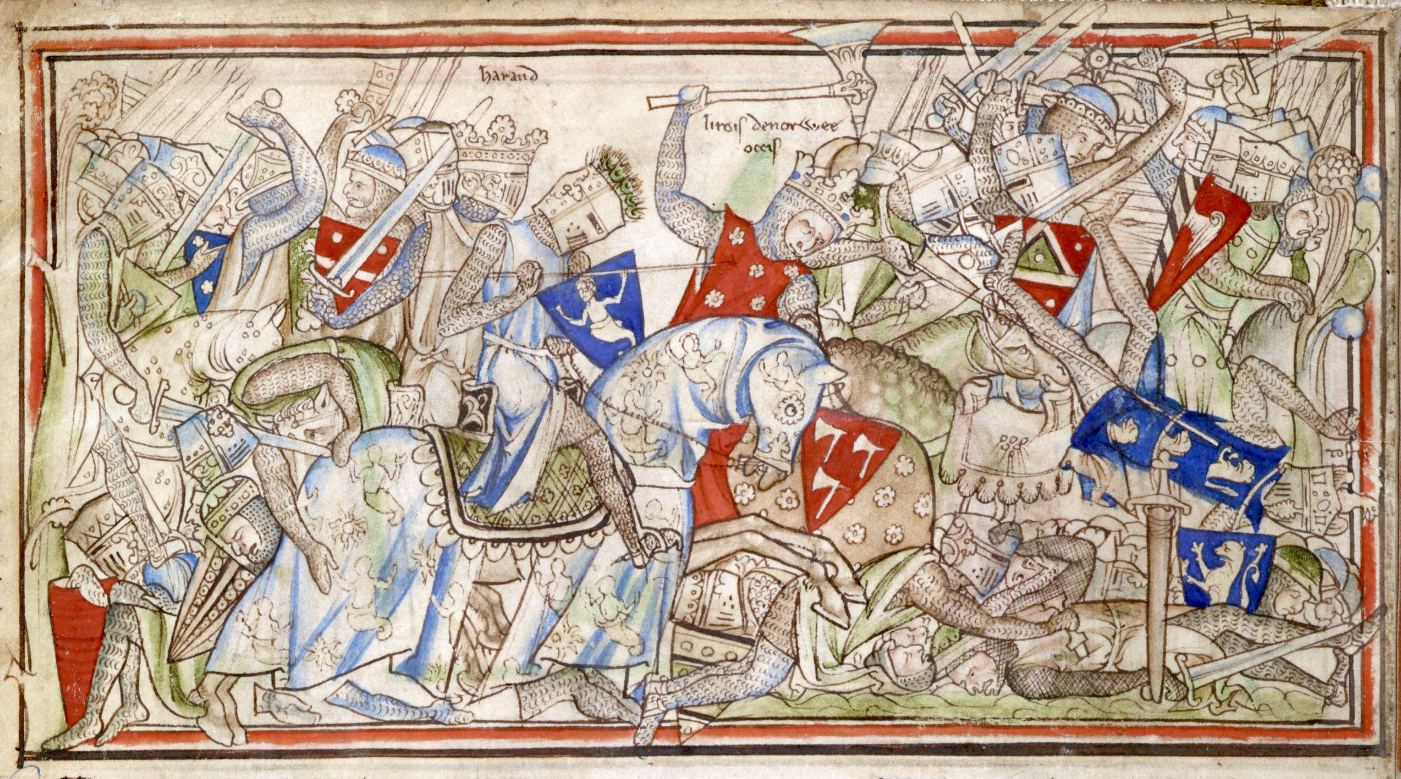
On September 25, 1066, King Harold Godwinson of England won a decisive victory at the Battle of Stamford Bridge in Yorkshire. Harold’s army surprised a Norwegian-led invasion force commanded by King Harald Hardrada of Norway and supported by Harold’s exiled brother, Tostig Godwinson. In the fierce fighting that followed, both Hardrada and Tostig were killed, and the Norwegian army was decisively defeated.
The battle ended Hardrada’s claim to the English throne and is often remembered as a symbolic endpoint of the Viking Age in England. That description requires some nuance: Scandinavian rulers continued to campaign in Britain after 1066. Still, Stamford Bridge marked a major turning point, weakening the long-standing political and military connection between England and Scandinavia.
For Harold, however, the victory came at a severe strategic cost. He had marched his army approximately 185 miles from London to Yorkshire in only four days before fighting a major battle. Historians cannot know precisely how much the northern campaign diminished his forces, but it gave him little opportunity to recover when a new invasion force appeared in the south.
Only 19 days later, on October 14, 1066, Harold met William, Duke of Normandy, at the Battle of Hastings. Harold was killed, the English army was defeated, and William’s victory opened the way for the Norman Conquest. The conquest transformed England’s ruling elite, landholding, architecture, government, and language. In later centuries, the more centralized royal administration and court system helped foster the English common-law tradition.
That legacy eventually reached North America. English colonists brought legal practices and political assumptions shaped by English common law, including jury trials, judicial precedent, property rights, and the principle that government should operate under law. During the American Revolution, colonists drew on English legal traditions, Magna Carta, and the claimed “rights of Englishmen” while resisting British rule. Combined with colonial experience and Enlightenment political thought, these influences helped shape American constitutional government and the U.S. legal system.
In that indirect but consequential sense, Harold’s victory at Stamford Bridge—and the Norman victory that followed at Hastings—helped set England on a historical path whose legal and political traditions later crossed the Atlantic and became part of the foundation of American history.
Image: The Battle of Stamford Bridge, from The Life of King Edward the Confessor by Matthew Paris, 13th century. Cambridge University via Wikimedia Commons, public domain.
