
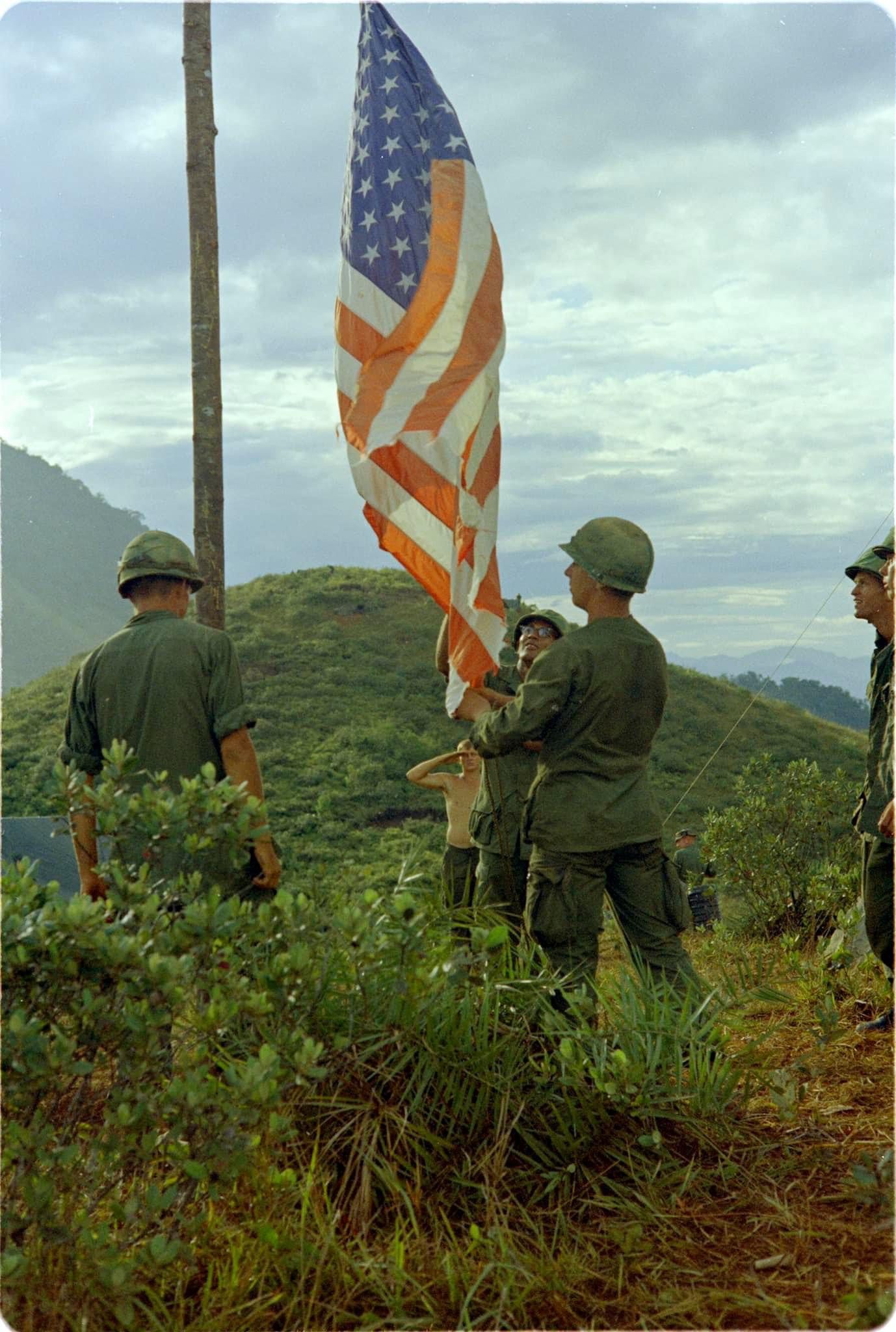
On September 8, 1967, during the Vietnam War, soldiers of Headquarters Company, 2nd Battalion, 502nd Infantry, 101st Airborne Division, raised the American flag on a high position known as “Ranger Hill” in the rugged mountains of Quảng Ngãi Province, South Vietnam. The battalion was then conducting search-and-destroy operations against North Vietnamese Army and Viet Cong forces as part of Operation Cook.
Ranger Hill served as the battalion’s tactical command post during the wider operation, which also involved elements of the 4th Infantry Division and the 196th Infantry Brigade. Army Specialist Robert C. Lafoon of the Department of the Army Special Photo Office photographed the scene. The image captures a brief pause in field operations as paratroopers erected their flag above the jungle-covered terrain.
The photograph also illustrates an important feature of the war: control of terrain was often temporary. Rather than holding continuous front lines, U.S. and allied units frequently moved through remote valleys and mountain positions, searching, clearing, and securing areas before shifting to new objectives. In that context, Ranger Hill was not simply a symbolic location; it was a working command post in a difficult operational environment.
Lafoon’s photograph remains a direct visual record of the experience of soldiers in the field—shared labor, improvised positions, dense terrain, and a moment of ceremony amid an ongoing campaign. It is also a lasting image of the 101st Airborne Division’s “Screaming Eagles” during the war in Vietnam.
Image: Soldiers of the 2nd Battalion, 502nd Infantry raise the American flag on Ranger Hill, the battalion command post, South Vietnam, September 8, 1967. Photograph by Army Specialist Robert C. Lafoon, Department of the Army Special Photo Office; public domain.
