

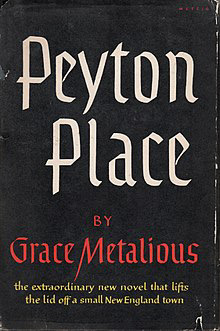
On September 8, 1924, author Grace Metalious was born Marie Grace DeRepentigny in Manchester, New Hampshire. Raised in a poor Franco-American family, she drew on her experience of New England mill-town life and its social hierarchies for her debut novel, Peyton Place, published by Julian Messner on September 24, 1956.
The book became a publishing sensation, selling millions of copies and becoming one of the defining bestsellers of its era. Yet its popularity came with fierce controversy. Set in a fictional New England town, Peyton Place stripped away the appearance of small-town respectability to address controversial issues—subjects that many readers and critics considered shocking for mainstream American fiction in the 1950s.
Many critics dismissed Metalious’s prose as crude or sensationalistic. But the force of her novel lay in its insistence that public virtue could coexist with private cruelty. Rather than presenting postwar community life as orderly and wholesome, Metalious exposed the resentments, exclusions, and secrets beneath its surface. Her portrayal resonated with a vast readership, even as it unsettled communities that saw uncomfortable similarities between Peyton Place and their own towns.
The success of Peyton Place demonstrated the cultural and commercial power of popular fiction willing to address taboo subjects. It was adapted into a major 1957 film and later an ABC prime-time serial, but both versions softened much of the novel’s frankness; the film, in particular, was constrained by the Hays Code, and Metalious criticized it as sanitized.
Metalious’s career remains a reminder that commercially successful literature can also be socially disruptive. With Peyton Place, she helped bring hidden aspects of American community life—sexual violence, class inequality, private shame, and institutional hypocrisy—into a more public conversation.
Image via Wikimedia Commons; public domain.
