
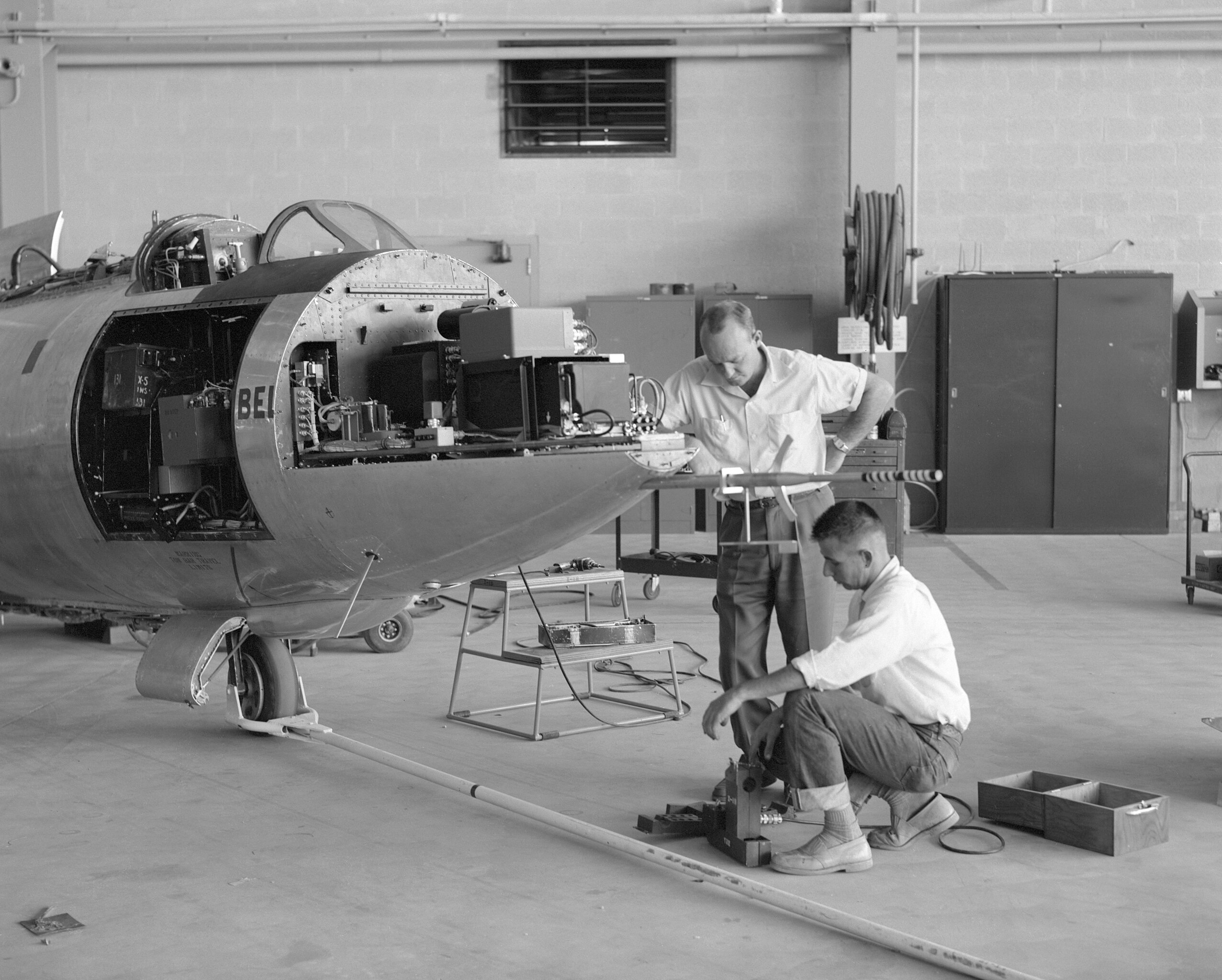
On June 16, 1956, technicians Lee Adelsbach and Bob Cook of the National Advisory Committee for Aeronautics (NACA) were photographed meticulously installing advanced instrumentation aboard the Bell X‑1B, one of the experimental rocket-powered aircraft designed to push the boundaries of high-speed flight. The X‑1B, an evolution of the original X‑1 that first broke the sound barrier, was equipped with sophisticated sensors to measure aerodynamic heating, stability, and control behavior at extreme velocities. The work performed by Adelsbach and Cook on this June day represented a crucial step in preparing the aircraft for a series of groundbreaking research missions.
Their efforts contributed directly to the United States’ expanding knowledge of supersonic and transonic flight, laying the scientific foundation for future aerospace innovations ranging from high-performance military jets to the early stages of spaceplane development. The photograph of the two technicians bent over the aircraft’s open fuselage has since become an iconic image within the NACA and NASA archives, symbolizing the quiet, methodical labor that underpinned America’s rise as a global leader in aviation research.
