
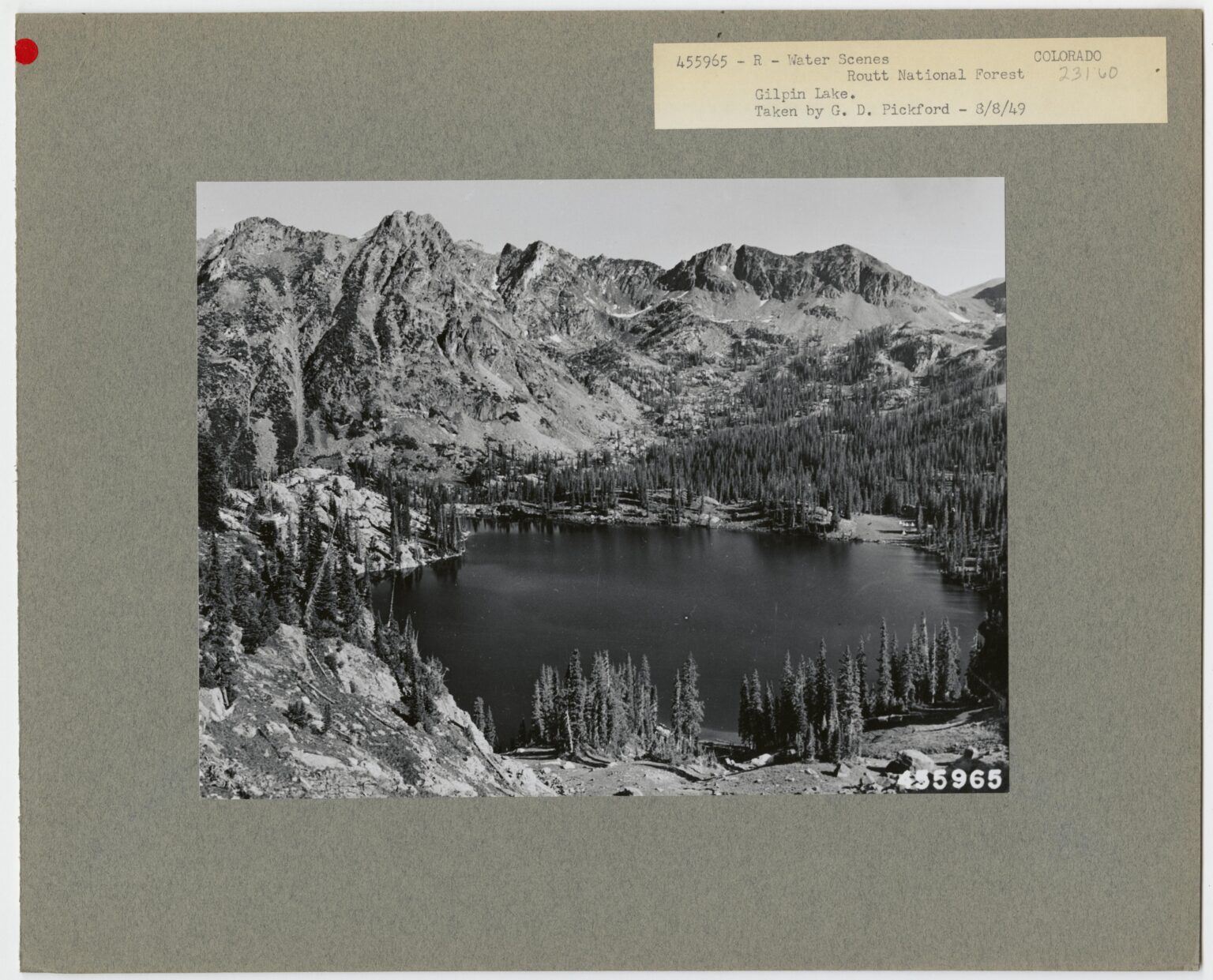
Gilpin Lake, Routt National Forest – August 8, 1949. Photographed by G.D. Pickford for the U.S. Forest Service, this black-and-white image captures the alpine serenity of Gilpin Lake in Colorado’s Routt National Forest. Taken on August 8, 1949, the scene reflects postwar America’s growing embrace of wilderness as both recreational escape and national heritage.
Nestled among pine forests and rugged peaks, Gilpin Lake stands as a witness to the era’s conservation ethos—where federal agencies documented nature not just for management, but for memory. Though its depths have not been officially confirmed, the lake has long sustained cold-water fish species. Brook trout were likely present in earlier decades, while recent reports suggest cutthroat trout may inhabit these alpine waters—whether through natural migration, unofficial stocking, or misidentification remains unclear.
The image captured by Pickford represents a distinct cultural shift in how federal land management agencies operated following the conclusion of World War II. As millions of middle-class families bought cars and hit the newly expanding highway systems, the U.S. Forest Service had to transition from treating national forests purely as commercial timber reserves into protecting them as sacred natural sanctuaries for public health and leisure. This photograph acted as a piece of visual advocacy, proving that preserving the wild, untouched topography of places like Gilpin Lake was an essential investment in the spiritual identity of a modern, industrialized nation.
Image via Wikimedia Commons, public domain
