
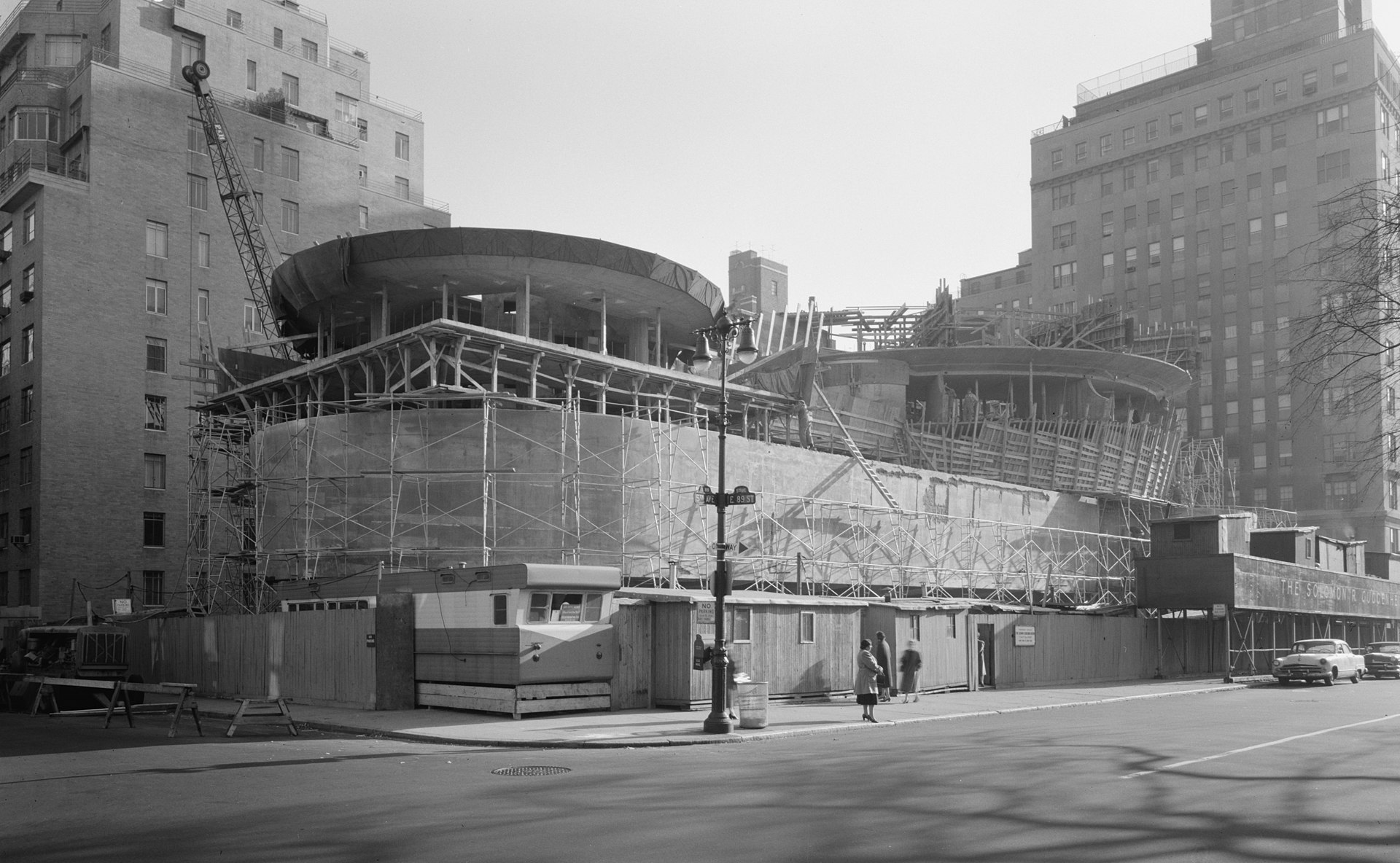
On October 21, 1959, the Solomon R. Guggenheim Museum opened its doors on New York City’s Fifth Avenue, introducing a bold alternative to the conventional art museum. Commissioned in 1943 to house Solomon R. Guggenheim’s collection, Frank Lloyd Wright’s design took sixteen years to reach completion. Wright died six months before the opening, leaving one of his most distinctive architectural achievements to welcome the public without him.
Instead of organizing the main exhibition space as a succession of rectangular rooms, Wright designed a continuous spiral ramp winding around a vast central rotunda beneath a glass skylight. The ramp widened as it rose, giving the building its unmistakable inverted-ziggurat form. Wright conceived the interior as one connected space, making movement through the building part of the experience of viewing art.
The design also provoked resistance. Before the museum opened, prominent artists protested that its sloping ramp and curved walls would compete with the paintings displayed inside. When visitors finally entered in 1959, the relationship between the building and its art became a defining subject of debate: was the architecture an extraordinary setting for the collection, or an artwork that threatened to overshadow it?
The Guggenheim became an architectural icon without entirely escaping that question. In 2019, it joined seven other Wright buildings on the UNESCO World Heritage List as part of The 20th-Century Architecture of Frank Lloyd Wright—recognition of a legacy in which the museum’s spiral remains one of the most recognizable expressions.
Photo Caption:
The Genesis of the Spiral — Constructing the Guggenheim
The Solomon R. Guggenheim Museum under construction on Fifth Avenue in New York City, 1957. Frank Lloyd Wright’s expanding spiral took shape around a central rotunda, creating a striking alternative to conventional museum galleries. The building opened to the public on October 21, 1959, six months after the architect’s death.
