
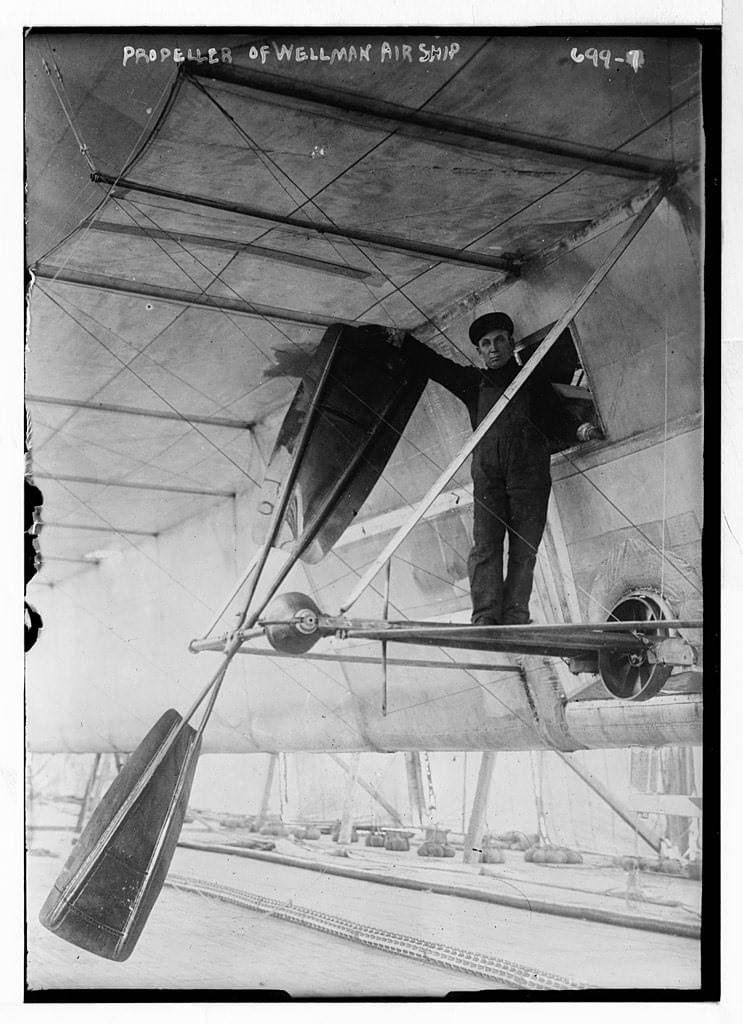
On October 15, 1910, the ambitious dirigible America rose from Atlantic City, New Jersey, on one of aviation’s boldest early challenges: the first attempt to cross the Atlantic Ocean by powered aircraft. At the helm was Walter Wellman, a journalist, explorer, and veteran polar adventurer who had already tried and failed to reach the North Pole by air, but now set his sights on Europe, roughly 3,000 miles away across the open ocean. The America was an enormous non-rigid airship, enlarged for the attempt to roughly 345,000 cubic feet and fitted with engines, a lifeboat, and one of the earliest radio sets ever carried aboard an aircraft. Its most unusual feature was an equilibrator, a long cable-and-weight arrangement designed to trail over the sea to keep the airship at a steady altitude. The accompanying photograph captures the scale of the undertaking, showing a crew member dwarfed beside the massive propeller assembly intended to drive the vessel through headwinds and storms.
Among the crew was an unexpected passenger named Kiddo, a gray tabby cat brought aboard as a mascot and good-luck charm. Kiddo evidently disagreed with the flight plan, and his loud protests during the launch inspired one of the first radio transmissions from an aircraft in history, as engineer Melvin Vaniman reportedly radioed the launch boat to come and get the cat. Despite the feline objections, the America made steady progress for a time, but the North Atlantic proved merciless. The engines failed about 38 hours into the flight, severe storms battered the airship, and the crew struggled constantly to keep the fragile, hydrogen-filled craft under control. After about 71½ hours aloft and a journey of roughly 1,008 miles, the crew was forced to send out the first aerial-to-ship radio distress call on October 18.
West of Bermuda, the British Royal Mail steamship Trent answered the distress signal and came to the rescue. The crew, along with Kiddo the cat, safely climbed into the America’s specialized lifeboat and cast loose from the drifting airship, which was never recovered and disappeared forever into the Atlantic. Although Wellman and his crew did not reach Europe, their historic flight was far from a total failure. The America set grand records for time aloft and distance traveled by air, and its voyage demonstrated both the promise and the peril of long-distance aviation. Years before the first successful nonstop transatlantic flight, the America had already shown that crossing an ocean by air was no longer pure fantasy, but rather an immensely difficult engineering problem waiting to be solved.
Image via Wikimedia Commons, public domain
