
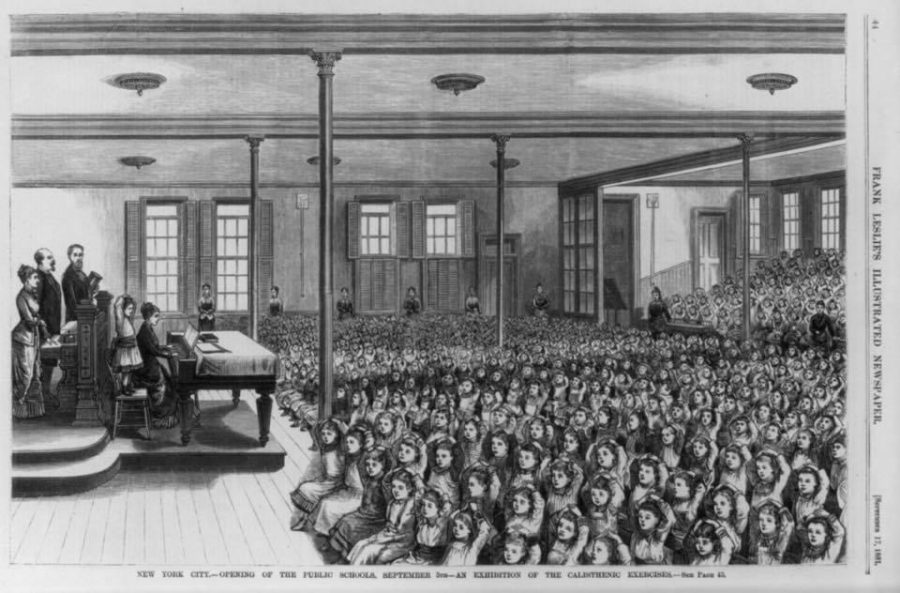
On September 5, 1881, the opening day of New York City’s public-school term included a public exhibition of calisthenic exercises. An illustration published in Frank Leslie’s Illustrated Newspaper depicts large groups of students performing synchronized drills—movements intended to cultivate posture, health, coordination, and orderly conduct. The caption identifies the scene as “New York City—Opening of the Public Schools, September 5th—An Exhibition of the Calisthenic Exercises.”
The display reflects the expanding place of physical culture in late-nineteenth-century schooling. Advocates of calisthenics and light gymnastics promoted structured exercise for both home and school, framing it as an important part of children’s physical development rather than simply recreation. In crowded urban classrooms and neighborhoods, these drills could be understood as a response to sedentary routines and contemporary concerns about children’s health.
The exercises also made discipline visible. Rows of similarly positioned bodies transformed the school into a scene of collective order, where posture, timing, and obedience could be practiced and publicly displayed. In a city shaped by rapid growth and immigration, public education often treated such routines as part of civic formation and social integration. Calisthenics therefore served not only as early physical education, but also as a way of teaching children to move—and, by implication, to belong—within an ordered public world.
Image: “New York City—Opening of the Public Schools, September 5th—An Exhibition of the Calisthenic Exercises,” 1881, published in Frank Leslie’s Illustrated Newspaper. Library of Congress; no known restrictions.
