
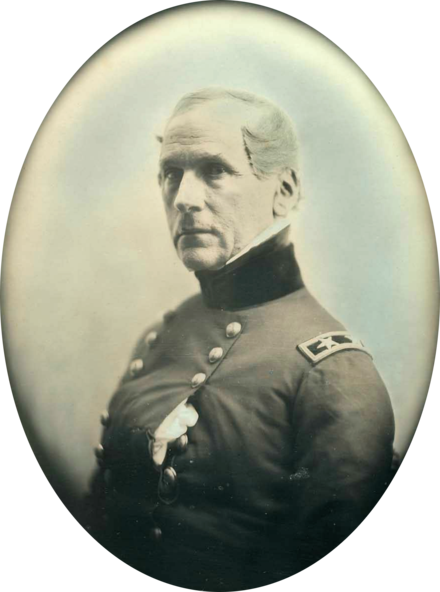
On October 13, 1812, Captain John Ellis Wool of the United States Army was shot through both thighs during the Battle of Queenston Heights in Ontario. Despite his wounds, he helped lead an American detachment up a steep, unmarked fisherman’s path and seize British artillery batteries atop the heights. His initiative produced one of the few American successes in an otherwise disastrous early campaign on the Niagara frontier during the War of 1812.
Wool recovered and remained in the Army for more than fifty years, serving through the War of 1812, the Mexican-American War, and the opening years of the Civil War. Already a brigadier general by 1841, he earned a brevet promotion to major general for his role at the Battle of Buena Vista in 1847, where his battlefield judgment helped Zachary Taylor’s smaller army repel a larger Mexican force.
During the Civil War, Wool helped secure Fort Monroe and Norfolk for the Union and was appointed a full major general in 1862. He retired from active service on August 1, 1863, at age 79, after a career that spanned the transformation of the U.S. Army from the early republic to the Civil War.
