
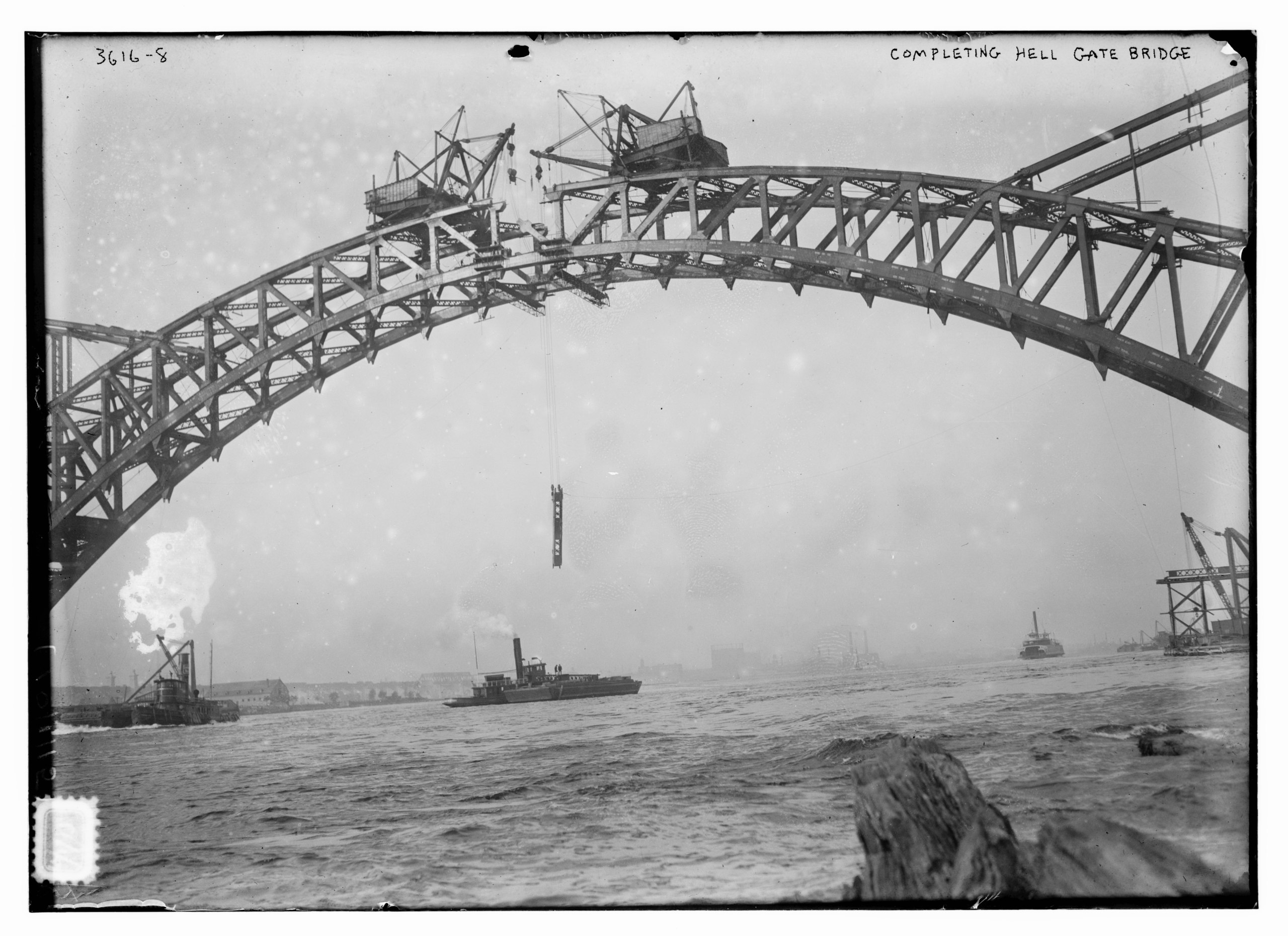
Civil engineering history marked a major milestone on September 30, 1916, when construction of New York City’s Hell Gate Bridge was completed. Spanning Hell Gate, the turbulent East River strait between Queens and Wards Island, the massive steel arch was designed by engineer Gustav Lindenthal as the essential link in the New York Connecting Railroad, connecting the Pennsylvania Railroad’s network with the New Haven Railroad and opening a direct rail route between New England and the Mid-Atlantic.
The site posed extraordinary engineering challenges. Because Hell Gate was a busy, navigable waterway, the bridge could not rely on falsework or support piers in midstream. Instead, engineers erected the two halves of the arch outward from the shores using a cantilever system supported by massive temporary backstays and hydraulic jacks. The arch halves met over the channel in 1915 with remarkable accuracy, after which the structure became self-supporting and the temporary works could be removed.
The bridge’s central arch measures roughly 1,017 feet, with 977 feet between the tower centers, and it was the world’s longest steel-arch span when completed. Its final completion in 1916 finished the principal engineering work on a rail connection that would reshape Northeast travel and commerce. The New York Connecting Railroad was formally dedicated on March 9, 1917; revenue passenger trains began crossing the bridge on April 1, 1917.
Image credit: “Completing the Hell Gate Bridge,” September 1916, via Wikimedia Commons, public domain.
