
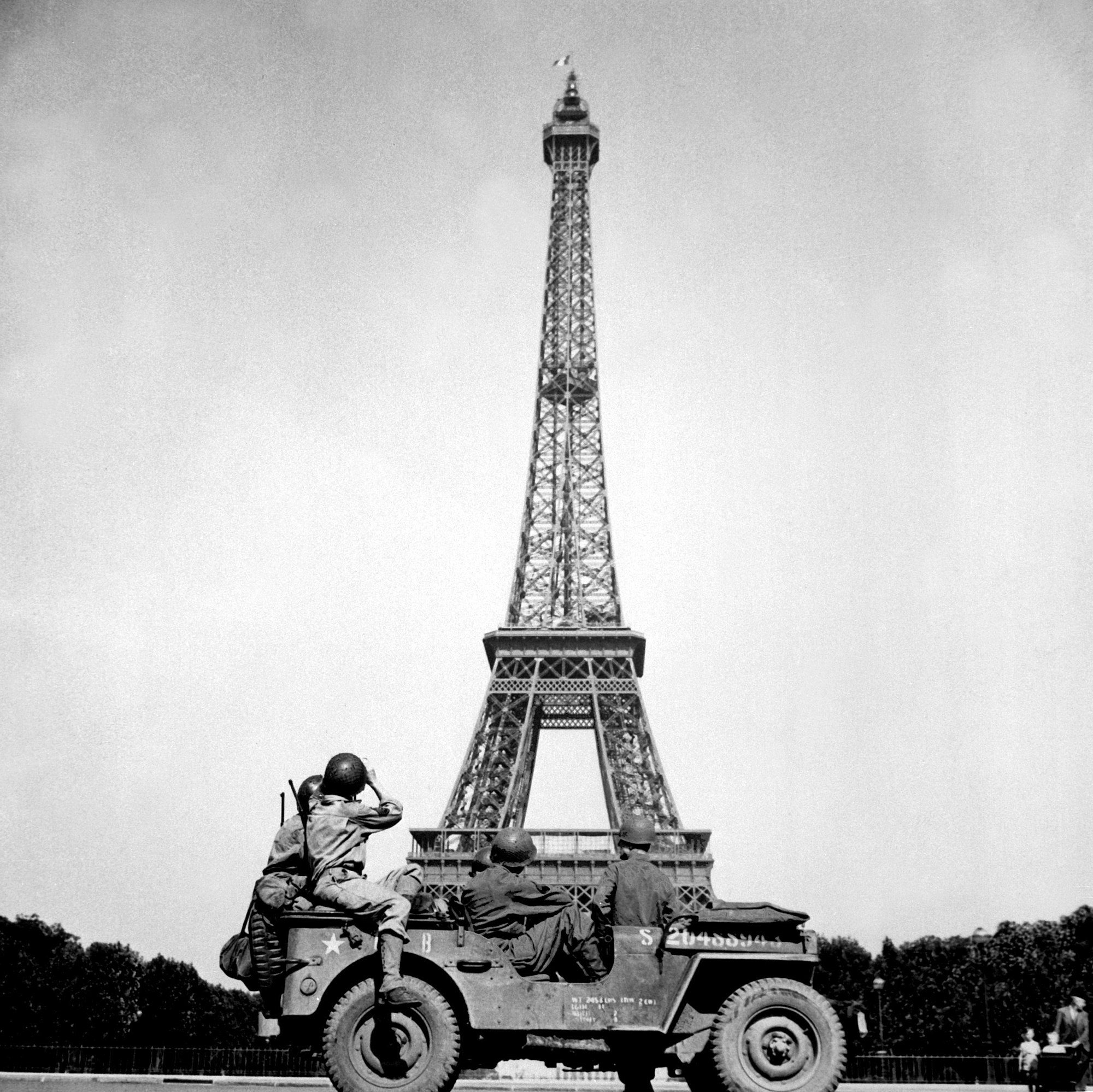
On August 25, 1944, soldiers of the U.S. 4th Infantry Division gathered beneath the iron lattice of the Eiffel Tower as Paris celebrated its liberation from four years of Nazi occupation. The moment marked the culmination of a fast‑moving Allied advance and a decisive victory for Free French and American forces during the late stages of the European campaign.
The liberation unfolded after a dramatic, citywide uprising led by the French Resistance, whose fighters seized police stations, cut German communication lines, and erected barricades throughout the capital. Their revolt forced the German garrison into a defensive spiral just as General Philippe Leclerc’s 2nd Armored Division pushed into the city. Working in close coordination, American units advanced through the outer arrondissements to secure key intersections, reinforce Free French armor, and prevent German demolition teams from destroying Paris’s historic landmarks.
The collapse of German control triggered an outpouring of public jubilation. Crowds surged onto the boulevards, showering the liberating troops with flowers, embraces, and the raw emotion of a city reclaiming its identity. The liberation of Paris delivered a major strategic blow to German logistics in northern France, opening vital transport corridors and accelerating the Allied drive toward the Rhine. This documentary image of American infantrymen gazing up at the Eiffel Tower endures as one of the most iconic photographs of the war — a symbol of liberation, Franco‑American cooperation, and the moment sovereignty returned to the cultural heart of Western Europe.
Image via Wikimedia Commons, public domain.
