
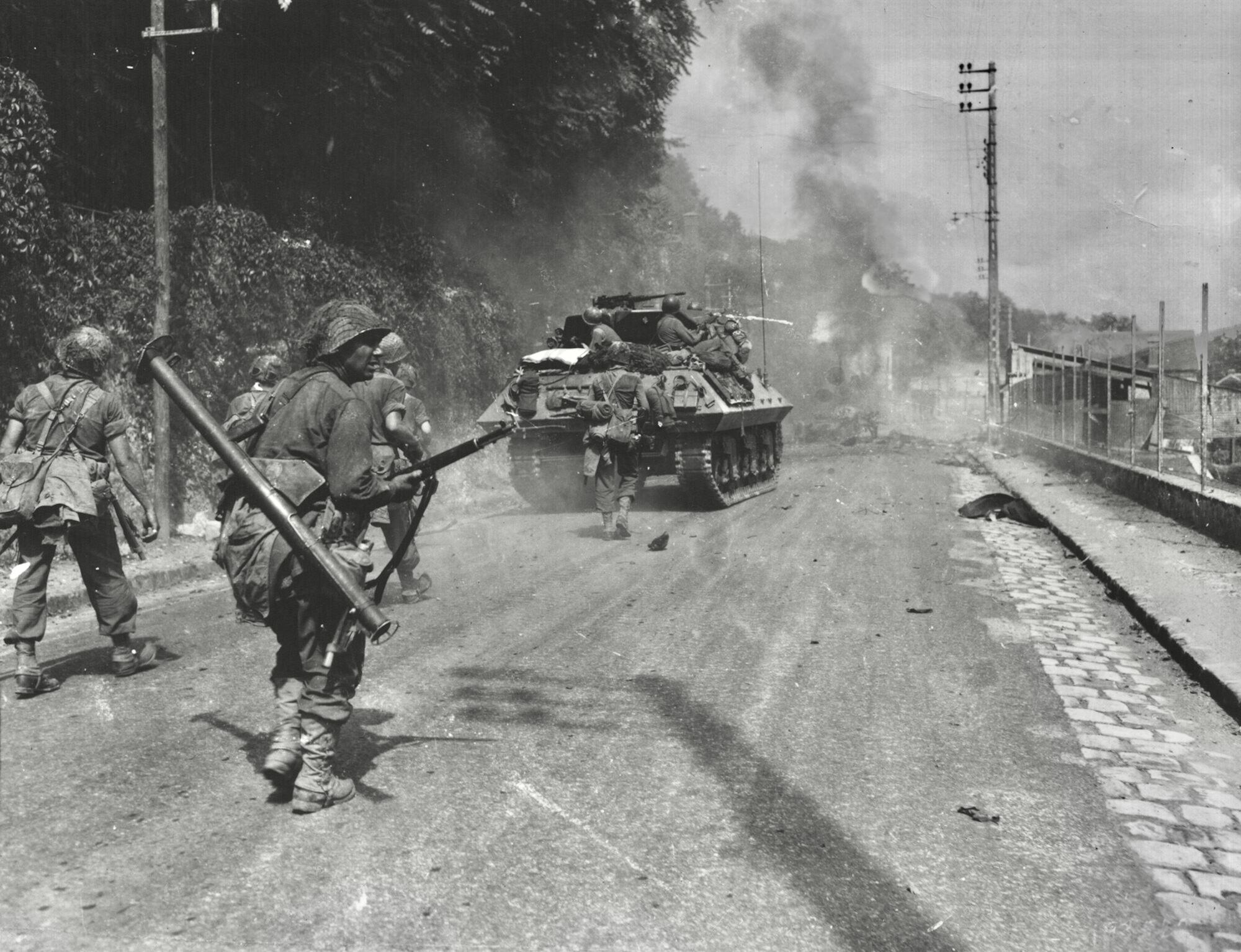
As American troops pushed rapidly through the newly liberated streets of Fontainebleau, France, on August 23, 1944, the collapse of the German defensive line opened the way for a high‑speed Allied encirclement of Paris. In this Signal Corps photograph, a soldier strides forward with an M1A1 Bazooka slung across his back — an unmistakable symbol of the tactical revolution reshaping infantry combat in World War II.
The presence of the portable rocket launcher in a frontline patrol underscored how profoundly the battlefield had changed. Before the advent of shaped‑charge rockets, infantrymen had no organic means of stopping armor and were forced to wait for slow, heavy artillery to break fortified positions. The Bazooka altered that equation overnight. By placing tank‑killing power on the shoulder of a single soldier, it gave light infantry the ability to crack machine‑gun nests, concrete bunkers, and armored threats without pausing the advance.
The photograph captures more than a moment in a French town — it records the mechanics of liberation itself. The soldier’s steady posture, the weapon’s silhouette, and the urgency of the column behind him form a visual ledger of how innovation, labor, and relentless forward motion helped drive the Allies toward the gates of Paris.
Image via Wikimedia Commons, public domain.
