
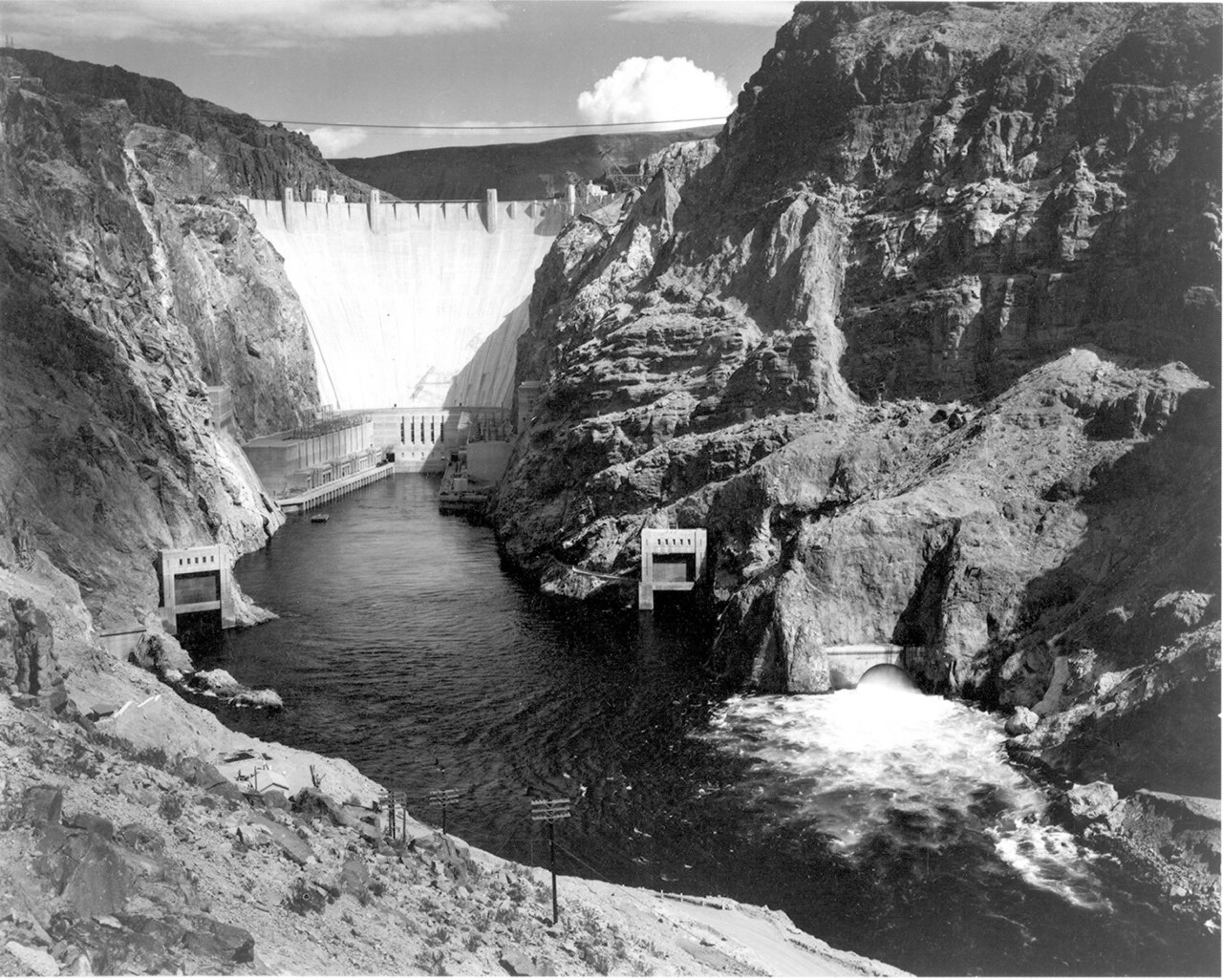
On September 30, 1935, President Franklin D. Roosevelt stood before a crowd of more than 10,000 spectators to dedicate Boulder Dam on the Colorado River, celebrating one of the era’s defining engineering achievements. Rising in Black Canyon on the Nevada–Arizona border, the vast concrete arch-gravity dam was designed to control destructive flooding, store and regulate Colorado River water for irrigation and municipal use, and generate hydroelectric power for the growing Southwest.
Built during the depths of the Great Depression by Six Companies, Inc., the project was completed more than two years ahead of schedule through a demanding, round-the-clock construction campaign. The dam rises 726 feet and required roughly 3.25 million cubic yards of concrete. To keep the immense mass of concrete from cracking as it cured, engineers installed an innovative system of embedded pipes that circulated chilled water through the structure. The final concrete was poured on May 29, 1935, only months before Roosevelt’s dedication ceremony.
The dam’s name carried its own political controversy. Secretary of the Interior Ray Lyman Wilbur initially designated the project Hoover Dam in 1930, and Congress made that name official in 1931. After Franklin Roosevelt took office, however, his administration generally referred to it as Boulder Dam—its earlier planning-era name—and Roosevelt used that name at the 1935 dedication. The name was not formally changed during that period; in 1947, Congress passed a joint resolution, signed by President Harry S. Truman, directing that it be known as Hoover Dam in federal law and records.
