
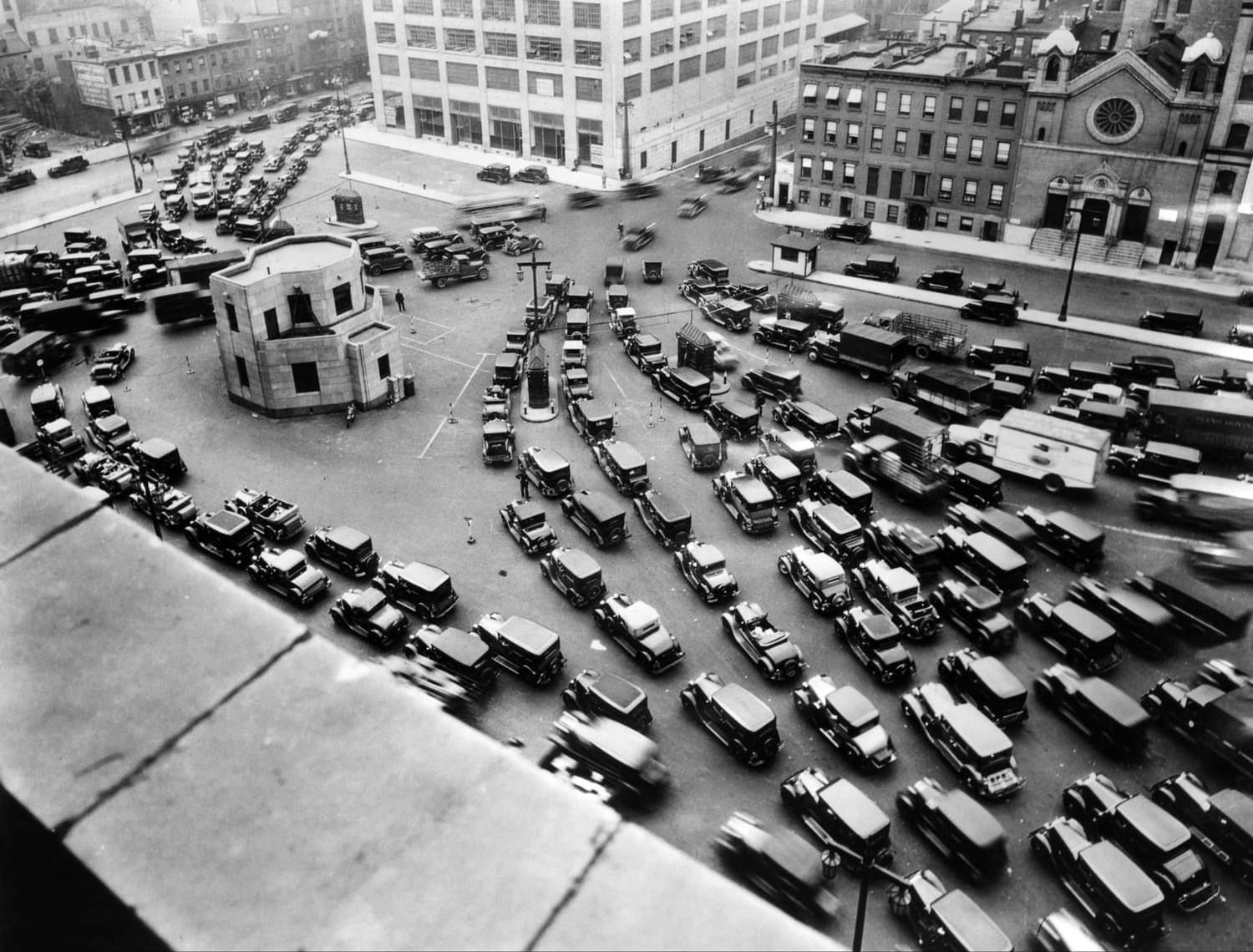
On November 13, 1927, the Holland Tunnel opened to public vehicular traffic, connecting Manhattan with Jersey City, New Jersey, beneath the Hudson River. The approximately 1.6-mile crossing was the longest underwater vehicular tunnel in the world at the time. Named for its first chief engineer, Clifford Milburn Holland, who died before its completion, it represented a major achievement in early twentieth-century civil engineering.
One of the project’s greatest challenges was ventilation: how to prevent dangerous concentrations of carbon monoxide from automobile exhaust inside a long, enclosed roadway. Ole Singstad, who became chief engineer after the deaths of Holland and his successor, Milton H. Freeman, developed the tunnel’s pioneering transverse ventilation system. Eighty-four fans housed in four ventilation buildings supplied fresh air through ducts beneath the roadway and removed polluted air through ducts above the ceiling. Operating at full capacity, the system could replace the tunnel’s air every ninety seconds.
The tunnel’s opening demonstrated the enormous demand for a direct road connection beneath the Hudson: 52,285 vehicles passed through on its first day. Its engineering influence extended far beyond the New York metropolitan region, establishing a ventilation model for subsequent vehicular tunnels. In 1984, the American Society of Civil Engineers and the American Society of Mechanical Engineers jointly recognized the Holland Tunnel as a National Historic Civil and Mechanical Engineering Landmark—a tribute to an achievement that made long underwater road crossings both practical and safer.
