
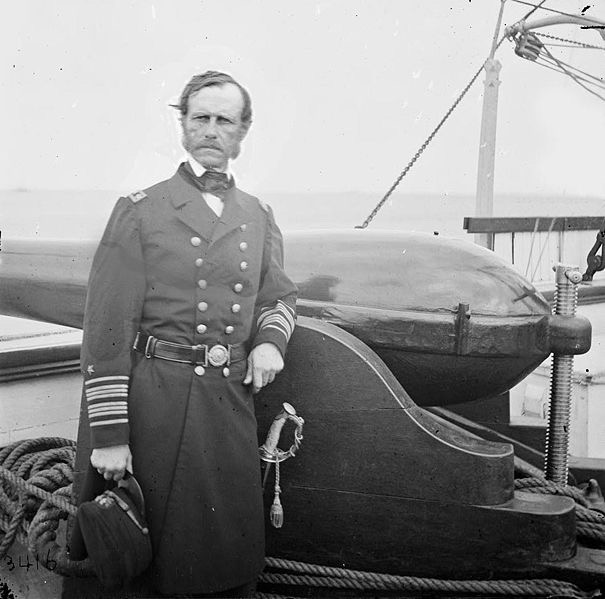
Born on November 13, 1809, in Philadelphia, Pennsylvania, John Adolphus Bernard Dahlgren became one of America’s leading naval ordnance innovators. He entered the United States Navy as a midshipman in 1826 and, after years of naval service, began the work at the Washington Navy Yard in 1847 that would establish his reputation. There, he brought systematic experimentation to the design and testing of naval artillery, helping transform the firepower of the American fleet.
Dahlgren pursued his work against a background of deadly gun failures, including the 1844 explosion aboard USS Princeton. The danger became especially immediate in November 1849, when a 32-pounder burst during testing near him, killing its gunner. Early the following year, he submitted plans for new 9- and 11-inch guns. His characteristic smoothbore, muzzle-loading shell guns featured a distinctive “soda-bottle” profile: thick iron surrounded the breech, where firing pressures were greatest, while the barrel tapered toward the muzzle. This distribution of metal reflected his effort to combine powerful armament with greater safety.
During the Civil War, Dahlgren guns became the most common cannon aboard United States Navy ships, forming an important part of the Union fleet’s armament. His influence extended beyond individual weapons to the testing, inspection, and organization of naval ordnance. Promoted to rear admiral in 1863, he took command of the South Atlantic Blockading Squadron, directing naval operations along the Confederate coast, including those centered on Charleston, South Carolina.
The war also divided Dahlgren’s family. His younger brother, Charles G. Dahlgren, served the Confederate cause as a brigadier general in the Mississippi State Troops—a state military appointment, rather than a general’s commission in the Confederate Army. His son, Colonel Ulric Dahlgren, served in the Union cavalry and was killed on March 2, 1864, at the age of twenty-one, during the unsuccessful raid on Richmond. The admiral’s wartime service thus unfolded alongside both family division and personal loss.
Dahlgren’s enduring significance lies in his application of scientific methods to naval gunnery during an era of rapid technological change. Through experimental firing, improved gun design, and rigorous inspection procedures, he helped establish a more systematic approach to the development of naval weapons. The United States Navy remembers him as the “father of American naval ordnance”—a tribute to both his guns and the professional standards he helped advance.
A surviving photograph cataloged by the Naval History and Heritage Command shows Dahlgren standing beside a 50-pounder Dahlgren rifle aboard USS Pawnee in Charleston Harbor, circa 1863–1865. The rifled weapon represents a different branch of his ordnance work from the smoothbore shell guns for which he is best known. The image preserves a fitting record of an officer whose engineering achievements helped arm the Union fleet while his family experienced the divisions and losses of the Civil War.
