
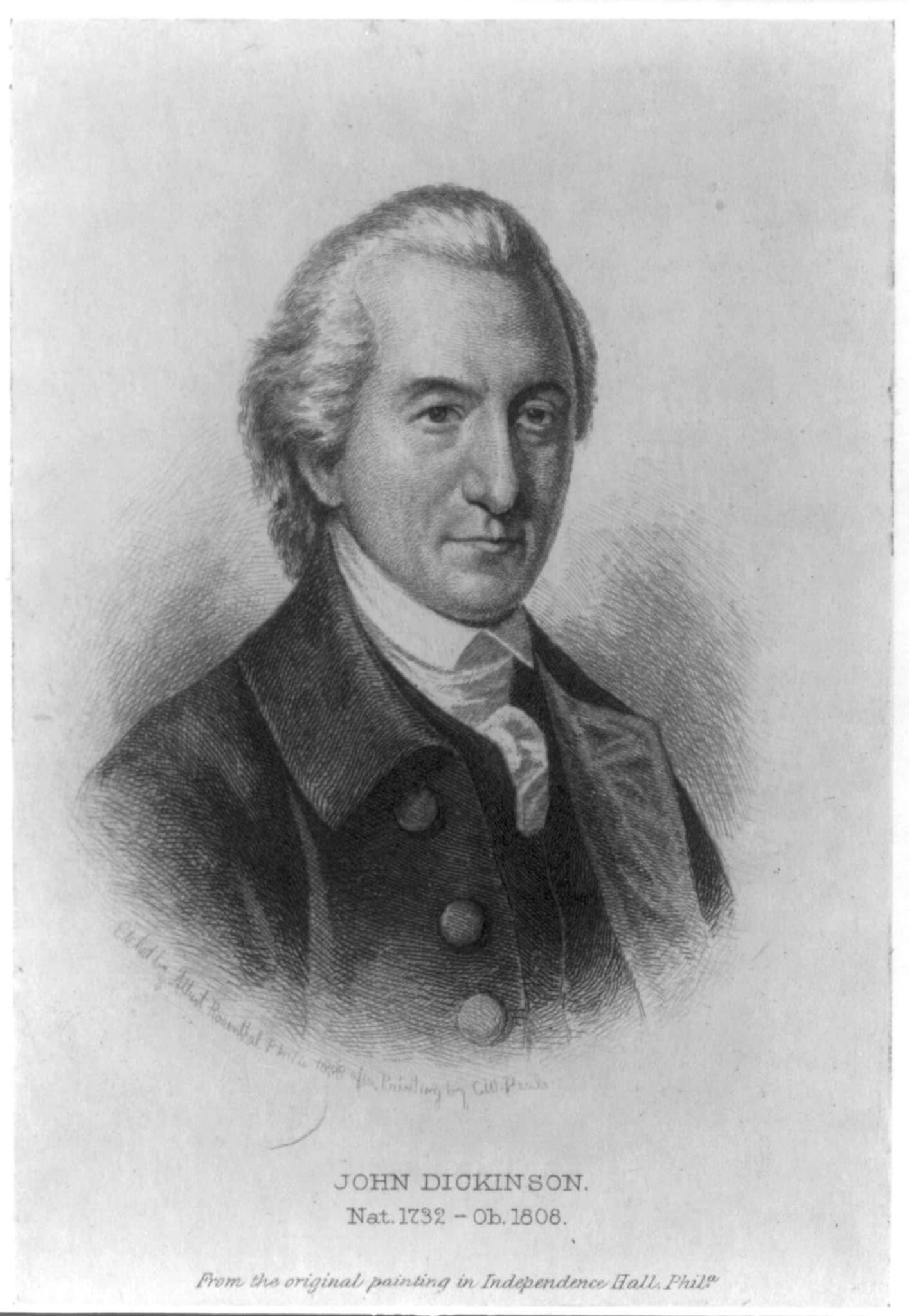
Born on November 13, 1732, in Talbot County, Maryland, John Dickinson became one of the American founding era’s most influential political writers. Remembered as the “Penman of the Revolution,” he gained widespread recognition through his Letters from a Farmer in Pennsylvania, published in 1767 and 1768. Challenging the Townshend duties, Dickinson drew a crucial constitutional distinction: Parliament could regulate imperial trade, but it could not legitimately tax the colonies to raise revenue without their consent. Reprinted throughout the colonies and read across the Atlantic, the letters helped turn separate grievances into a shared defense of American rights.
Dickinson’s resistance to British policy did not initially make him an advocate of independence. He favored negotiation and coordinated, peaceful resistance, believing that Americans could defend their liberties without abandoning their constitutional relationship with Britain. In July 1776, he opposed declaring independence before the colonies had secured foreign support and established a firmer framework for union. Rather than cast a final vote against independence, he absented himself from the proceedings and did not sign the Declaration. Once the decision was made, however, he supported the American cause through military service—first as a Pennsylvania militia colonel in 1776, then as a private in the Delaware militia in 1777. His caution about separation was not a refusal to share its risks.
His commitment to constitutional order also shaped the emerging republic. In 1776, Dickinson prepared the first draft of the Articles of Confederation, proposing a stronger central government than the states ultimately accepted. Representing Delaware at the Constitutional Convention of 1787, he helped advance the settlement embodied in the Great Compromise: representation by population in the House of Representatives and equal representation for the states in the Senate. His contribution reflected a persistent concern—how to create an effective union without extinguishing the political identities of its members. He later defended ratification through essays published under the name “Fabius.”
Dickinson expressed the importance of unity in popular verse as well as constitutional argument. His 1768 composition, “The Liberty Song,” urged Americans to stand together in defense of their rights:
Then join hand in hand, brave Americans all,
By uniting we stand, by dividing we fall.
The lines captured a theme running through his public career: collective action gave the colonies strength, but sustaining that strength required cooperation across their differences.
His legacy also carries the contradictions of the founding generation. A defender of liberty who had enslaved people and benefited from their labor, Dickinson eventually emancipated those he held in bondage and advocated abolition. That history complicates any simple celebration of his principles, while making his later efforts to extend them an important part of his record.
Remembering Dickinson on the anniversary of his birth brings a less familiar dimension of the Revolution into view. His career shows that resistance and restraint were not always opposites: the same writer who challenged British taxation also questioned the timing of independence and helped design the institutions that followed it. His enduring contribution lies not in standing apart from revolutionary change, but in insisting that the defense of liberty required more than a declaration—it required a workable, lasting constitutional order.
