
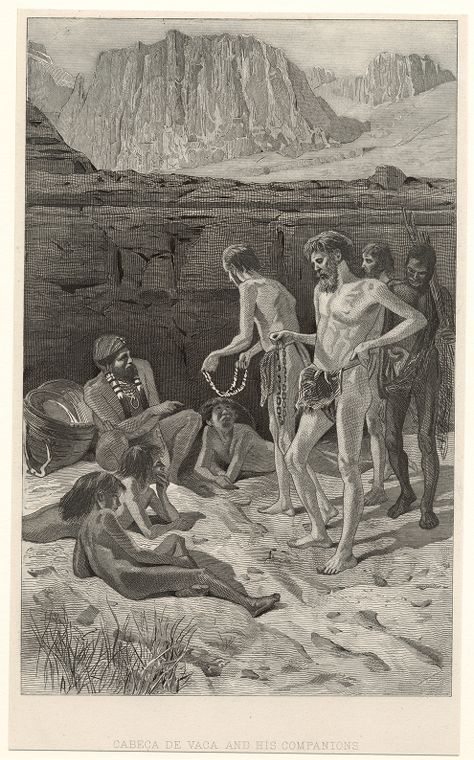
On November 6, 1528, Álvar Núñez Cabeza de Vaca and fellow survivors of the ill-fated Narváez expedition reached the Texas coast near present-day Galveston Island. Their makeshift boats had carried them across the Gulf after a disastrous expedition through Florida. Exhausted and desperately short of food, the castaways depended on Indigenous communities for assistance. Men who had entered North America as members of a colonizing expedition now faced the necessity of adapting to unfamiliar languages, customs, and ways of life.
Over the next eight years, Cabeza de Vaca experienced captivity, worked as a trader, and learned about the peoples among whom he lived. He eventually joined three other survivors: Andrés Dorantes de Carranza, Alonso del Castillo Maldonado, and Estevanico, an enslaved man from Morocco held by Dorantes. Together, they traveled through what are now Texas and northern Mexico, gaining a reputation as healers that helped them secure food and passage between communities.
In his later account, Cabeza de Vaca described healing practices that combined blowing on patients with Christian prayers and the sign of the cross. Whatever the medical basis of the reported recoveries, the castaways’ reputation became central to their survival and their relationships with the communities they encountered.
In 1536, the four encountered Spaniards north of San Miguel de Culiacán. Their return brought a disturbing confrontation with Spanish slave hunting. Cabeza de Vaca’s account contrasted the castaways’ conduct with the violence and exploitation of other Spaniards, presenting an argument for more humane treatment of Indigenous peoples—even as his outlook remained rooted in Christianity and Spanish colonization.
Published in 1542, his Relación preserved an invaluable early description of Indigenous life and the landscapes of Texas and northern Mexico. Its enduring power lies in the reversal at the heart of his experience: an aspiring conqueror survived through dependence on the people he had expected to encounter from a position of power.
