
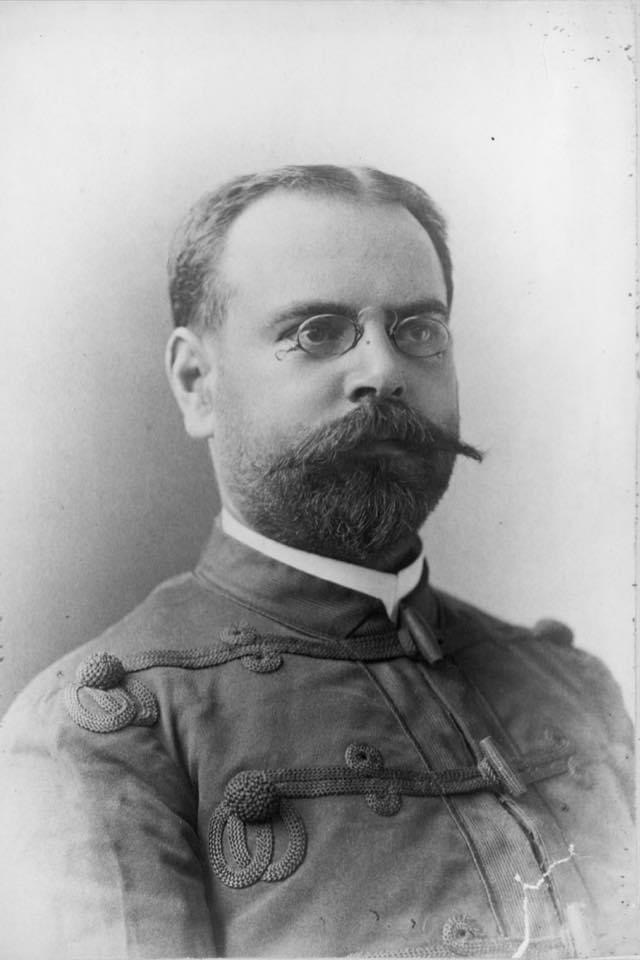
Born on November 6, 1854, in Washington, D.C., John Philip Sousa became one of the defining figures of American band music, earning international acclaim as “The March King.” The son of a musician in the United States Marine Band, Sousa grew up amid the military pageantry of the nation’s capital during the Civil War. At thirteen, when he nearly joined a circus band, his father intervened and enlisted him as an apprentice musician in the Marine Band. That early training laid the foundation for a career that would carry the sound of American military music far beyond the parade ground.
Sousa established his national reputation as the 17th leader of the United States Marine Band, serving from 1880 to 1892. Under his direction, the ensemble strengthened its reputation for musical excellence, and national tours brought its performances to audiences beyond Washington. In 1892, he left the Marine Band to form his own civilian concert band, which went on to win international acclaim. He also helped shape the development of the sousaphone, working with instrument makers to create a bass instrument suited to the sound he wanted from his ensemble. His influence extended beyond composition to the instruments, programming, and performance standards through which audiences experienced band music.
Sousa’s enduring achievement was to give musical expression to the energy and confidence of late-nineteenth-century American public life. He wrote more than 130 marches, including “The Washington Post” and “The Liberty Bell,” but his most celebrated work was “The Stars and Stripes Forever,” composed on Christmas Day in 1896. Later designated by Congress as the official national march of the United States, its brilliant piccolo lines and driving brass rhythms became a familiar expression of patriotic celebration. Through his compositions and performances, Sousa carried the disciplined rhythms of military music into concert halls and public gatherings, helping transform a martial tradition into a shared language of American civic life.
