
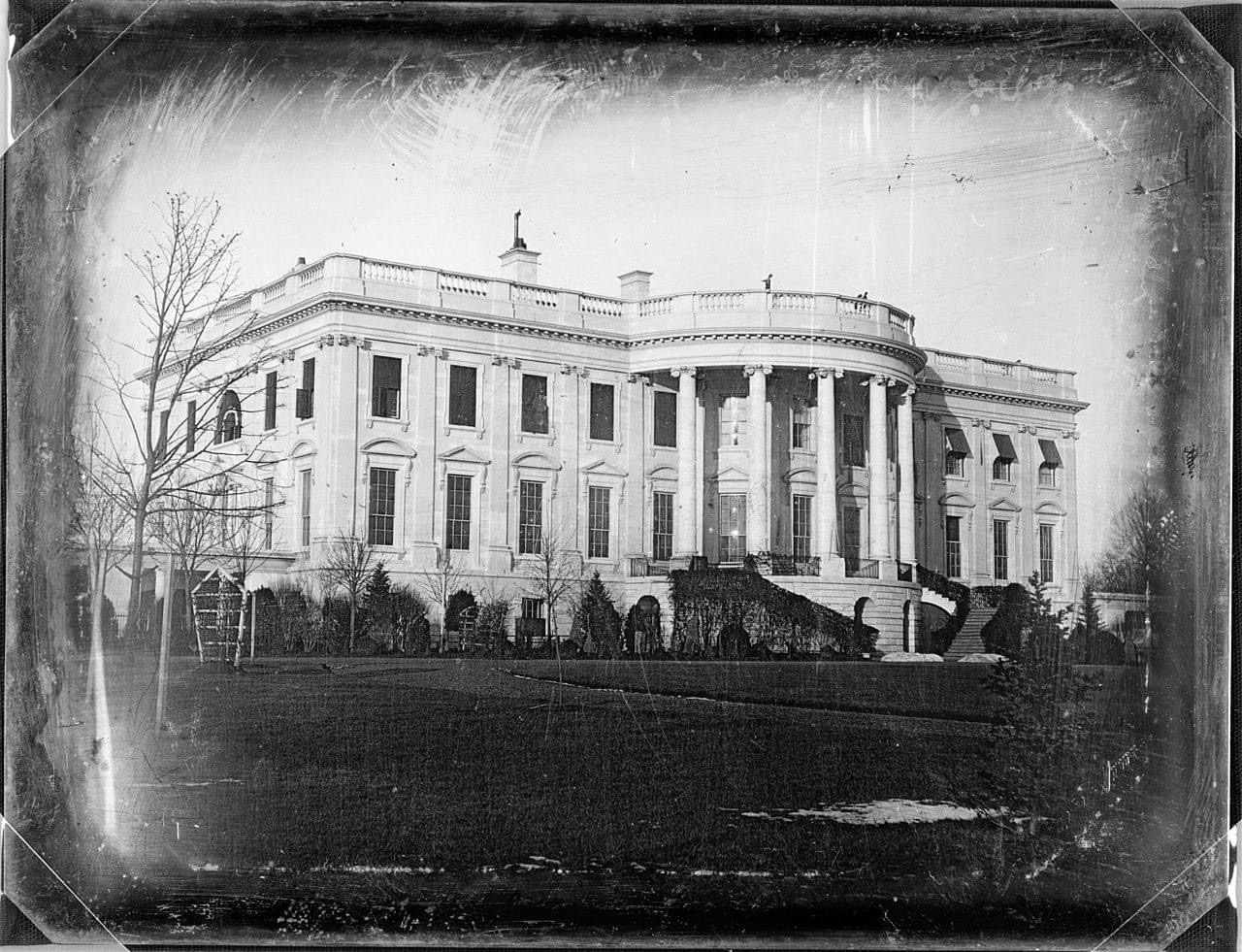
On October 13, 1792, a public ceremony brought together local Freemasons, District of Columbia commissioners, civic leaders, and workmen to lay the cornerstone of the President’s House in the newly designated Federal City. The event began at Suter’s Tavern in Georgetown and proceeded to the building site, where a brass plate commemorating the occasion was placed beneath the cornerstone.
The residence was designed by Irish-born architect James Hoban, whose proposal was selected in 1792. His Palladian-style design was modeled on Leinster House in Dublin, and construction relied on free and enslaved laborers as well as skilled craftsmen recruited from across the United States and Europe. Enslaved African Americans performed essential work, including clearing land, hauling materials, and contributing skilled labor to the project.
The building’s white-gray Aquia Creek sandstone was later whitewashed to protect it and give the residence its distinctive appearance. The cornerstone ceremony took place without President George Washington, who had helped select the site but never lived in the finished house; John and Abigail Adams moved into the still-unfinished residence in November 1800.
British troops burned the President’s House during the War of 1812, and it was rebuilt and enlarged under Hoban’s direction, reopening during James Monroe’s presidency in 1817. Although “White House” was used as early as 1812, President Theodore Roosevelt formally adopted the name in 1901. Today, the 1792 cornerstone ceremony marks the symbolic beginning of a building that has endured fire, reconstruction, and renovation while remaining the principal residence and workplace of the U.S. presidency.
