
Born on October 5, 1882, in Worcester, Massachusetts, American physicist and engineer Robert H. Goddard became one of the foundational pioneers of modern rocketry. Fascinated from an early age by the upper atmosphere and the possibility of spaceflight, he devoted his career to overcoming the scientific and engineering challenges of rocket propulsion. His theoretical and experimental work helped establish principles that would later underpin both missile technology and space exploration.
In 1914, Goddard received two landmark U.S. patents: one for a multistage rocket and another for a rocket powered by solid or liquid propellants. These ideas anticipated essential features of later launch vehicles. Nearly twelve years later, on March 16, 1926, Goddard successfully launched the world’s first liquid-fueled rocket in Auburn, Massachusetts, transforming a long-held theory into working engineering reality. The small gasoline-and-liquid-oxygen rocket rose about 41 feet during its 2.5-second flight.
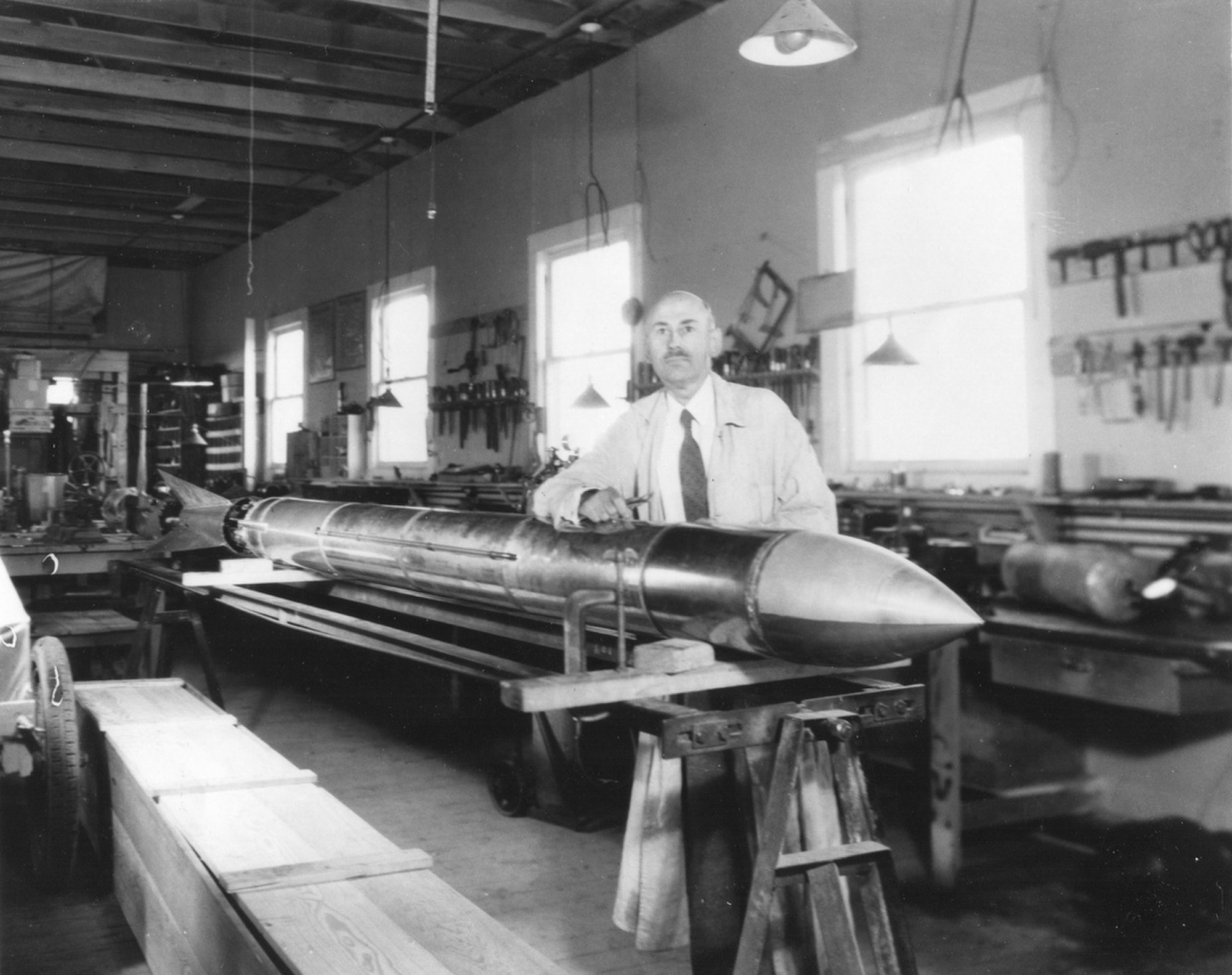
Goddard’s work was often misunderstood and ridiculed in his own time, yet he persisted, aided in later years by support from the Guggenheim Fund for the Promotion of Aeronautics. He relocated his experiments to Roswell, New Mexico, where he developed increasingly sophisticated rockets. A well-known photograph from October 1935 shows Goddard with a rocket in his Roswell workshop.
Although he did not live to see the Space Age fully unfold, Goddard’s achievements earned him lasting recognition as a father of modern rocketry and a central figure in the path toward space exploration.
