
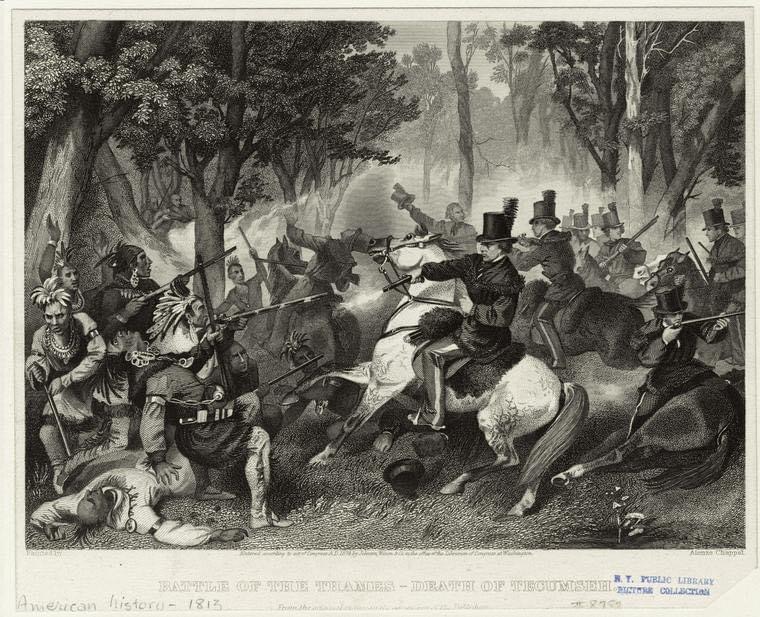
On October 5, 1813, the War of 1812 reached a decisive moment at the Battle of the Thames, near Moraviantown in present-day Ontario, Canada. As Major General William Henry Harrison’s American army closed in, Tecumseh and the British force under Major General Henry Procter faced an increasingly untenable position. The British and Indigenous defenders were outnumbered, poorly positioned, and threatened by the collapse of their retreat.
A poignant account of Tecumseh’s final hours appears in Benjamin Drake’s 1852 Life of Tecumseh and of His Brother the Prophet. According to that later biography, Tecumseh gathered fellow leaders before the fighting and predicted that he would not leave the battlefield alive. Drake wrote that Tecumseh removed his sword and belt, entrusted them to another chief, and asked that the sword be given to his son once the boy had become a warrior. The same account says that he removed his British military dress and entered the fighting in a deerskin hunting shirt.
The details of this scene are difficult to verify independently and are best understood as part of the enduring historical tradition surrounding Tecumseh’s death. What is certain is that Tecumseh was killed during the battle, as the British line collapsed and the Indigenous force was overwhelmed. The precise circumstances of his death and the disposition of his remains have long been disputed; his grave has never been conclusively identified.
Tecumseh’s death shattered the intertribal confederacy he had spent years building to defend Indigenous homelands and sovereignty. It did not end all Indigenous resistance in the region, but it severely weakened the possibility of a united Indigenous polity in the Old Northwest. In the decades that followed, many Indigenous nations east of the Mississippi faced accelerating land loss, coercive treaties, and forced removal.
